
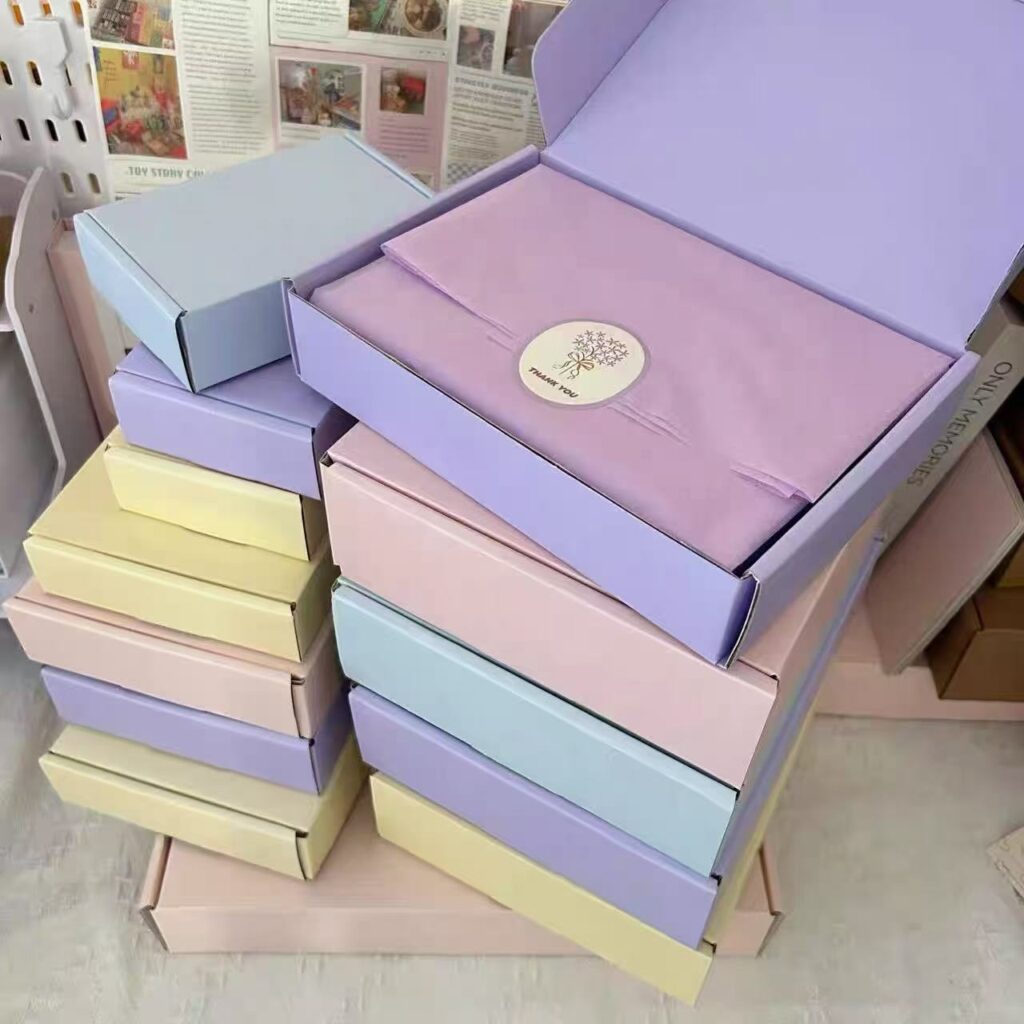
What it is and why brands love it
A mailer box is a flip-top, self-locking corrugated box. It’s cut from one die-cut sheet and folds up along score lines, so no tape is needed in most cases.
It combines protection, branding, and the unboxing moment in one format. When you close the lid, the lock clicks into place—clean, satisfying, and great for first impressions.
Where it’s commonly used
Direct-to-consumer shipping: pack and ship without a second outer box.
Subscription kits: monthly/quarterly branded boxes.
Launch & PR kits: influencer seeding, media boxes, first-release gift sets.
Keywords: flip-top, rolled edges, self-lock, tape-free, great unboxing.
Why it works (structure highlights)
Rolled, double-thick edges = strength
Side walls and the front lip roll inward to form two layers, adding thickness where it matters. This improves compression and impact resistance during stacking, sorting, and transit.
Front lock = secure without tape
The lid’s tongue(s) snap into lock slots on the front wall to create a mechanical lock. It won’t pop open in transit and is easy to re-close for returns.
Dust flaps = cleaner, safer packing
Inner dust flaps cover side openings to keep out debris and stop small items from slipping through.
Ships flat = saves space
Mailer boxes are delivered flat. You can store more units per carton, cut warehouse and freight costs, and pop them up in seconds on the packing line.
Tip: run a quick 30-second fold demo (roll edges → tuck dust flaps → lock front) for new packers—everyone gets it fast.
Common variants (pick what fits your use)
Standard mailer
The classic flip-top + front lock—works for most products.
Easy-open (tear-strip)
A built-in tear tape along the lid edge so customers open cleanly without a knife or scissors.
Double-lock front
Two locking tongues on the front edge for heavier loads or tamper resistance.
With handle or hang hole
Paper handle or euro-slot for retail display and click-and-collect.
Engineering note: these map to FEFCO 04xx patterns (e.g., 0426/0427), then fine-tuned with your brand’s die-line.
Materials & sizing (what to specify)
Which flute?
E-flute (≈1.2–1.8 mm): finer look, crisp creases, better print detail—great for subscription boxes and light items.
B-flute (≈2.5–3.5 mm): stronger compression for heavier goods or long-distance shipping.
E+B double-wall: best of both—presentation + strength for premium or heavier products.
Which liner?
Natural kraft: hides scuffs, eco look.
White kraft: higher contrast for bold color blocks and fine graphics.
Typical liners run 125–175 gsm; step up for heavier loads.
How to give dimensions
Provide internal size first (L × W × H, mm).
Add 2–5 mm clearance each side for the product plus tray/wrap/void fill.
If boxes must pass automated sorters or fit fixed outers, also share an external size range to avoid jams.
Tip: rolled edges and lock slots eat a little headroom—check effective internal height in your sample.
Best uses (quick cues)
DTC shipping: beauty, candles, coffee, merch, small electronics—ship and present with one box.
Subscription kits: story-rich graphics inside and out, designed for that “wow” moment.
Apparel accessories: tees, socks, scarves—pair with a light tray or kraft card base.
Gifting & PR: influencer mailers and event sets with both looks and structure.
Rule of thumb
Want nice look + smooth unboxing + shippable → choose a mailer.
Only need pallet stacking with no branding → a standard RSC shipper is cheaper.
Pros & limits (so you choose right)
Pros
Tape-free and fast: fold, click, done—packing speed goes up.
Stronger edges: rolled double walls resist corner crush and rough handling.
Big branding canvas: print inside and out for a full unboxing story.
Recycling-friendly: paper-only design supports single-material recovery.
Limits
High barrier or waterproof needs (cold chain, heavy grease) require liners, coatings, or a different format.
Uses slightly more board than a basic RSC (because of rolled edges and waste from the die-cut), though you often save on tape and improve CX.
First-time folding needs a quick teach-in: most packers get fluent after 3–5 boxes—record a 30-second SOP video to standardize.