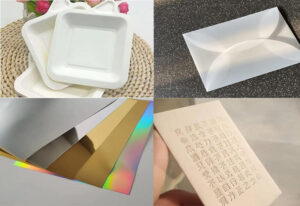
Panda Package Guide
Use this visual checklist before approving custom food packaging artwork. It helps packaging buyers and designers review label information, net content, barcode size, date marks, storage statements, product claims, packaging layers, and print-ready text size.
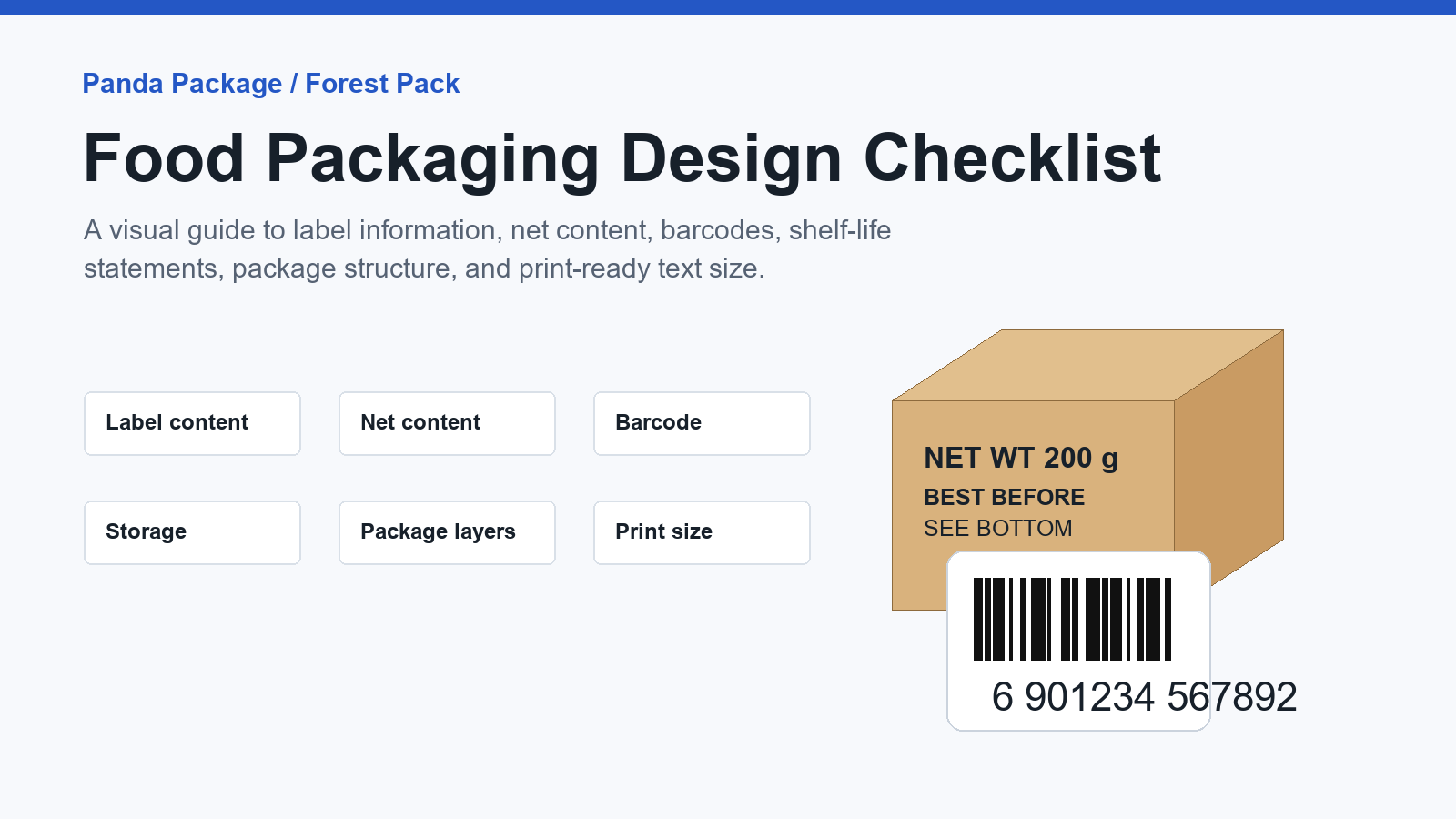
Good food packaging does more than look attractive on a shelf. It helps customers understand the product, protects the contents, supports retail scanning, and gives your production team a clearer path from artwork to print.
This guide is written for international packaging buyers who are preparing custom food boxes, food pouches, paper bags, sleeves, tubes, or gift-style food packaging. It is a practical design guide, not legal advice. Final label approval should always be checked against the rules of your target market.
What This Checklist Covers
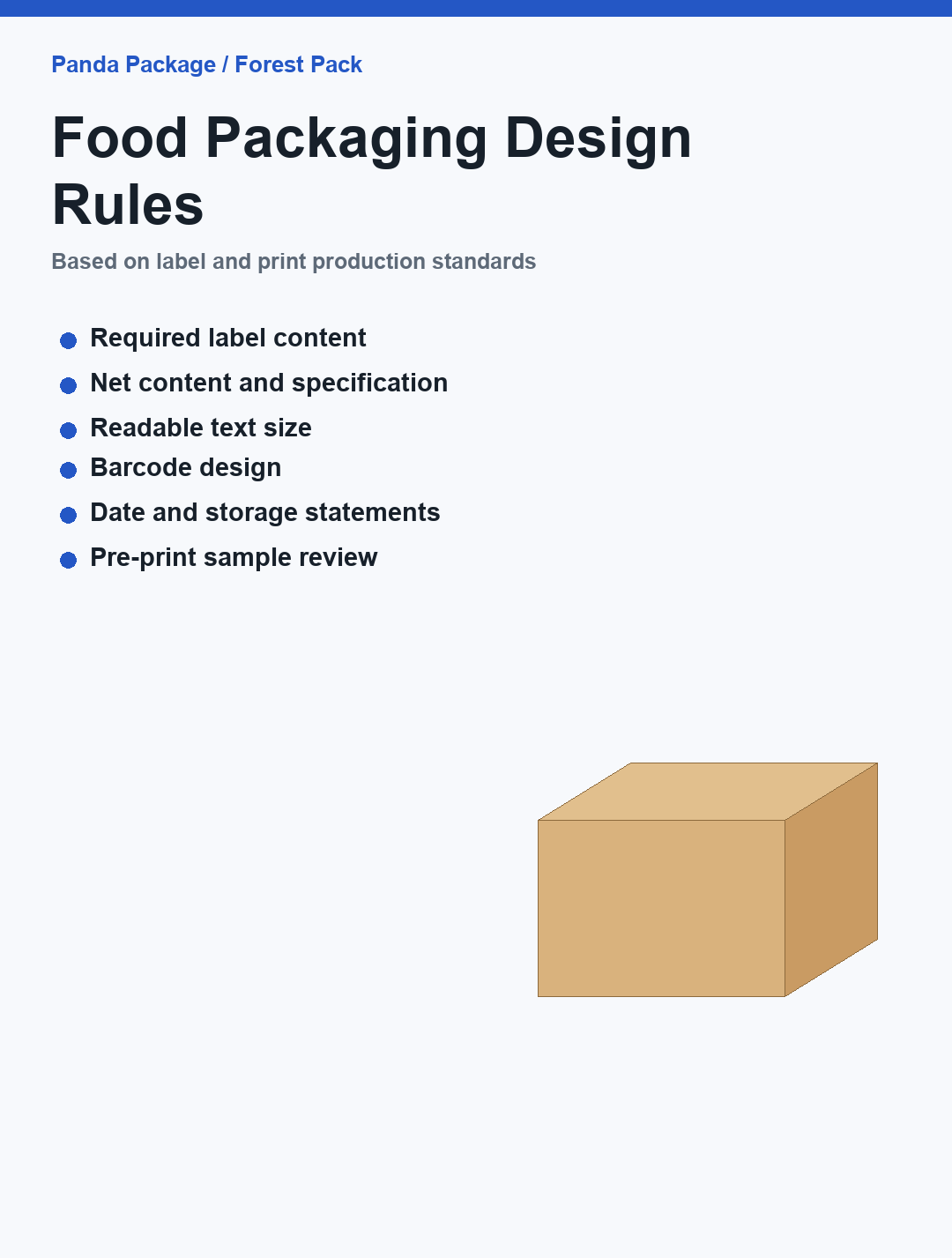
Quick Pre-Print Checklist
- Product nameClear, accurate, and not misleading.
- Label contentMandatory label information is easy to find.
- Net contentCorrect unit, correct format, readable size.
- Date and storageSpecific shelf-life wording and storage conditions.
- BarcodeRegistered, correctly sized, and tested on the sample.
- Panel consistencyFront, back, side panels, and inner packs match.
- Marketing claimsHealth, treatment, beauty, or prevention claims are reviewed.
- Packaging structureLayer count, empty space, and cost stay reasonable.
1. Required Label Information
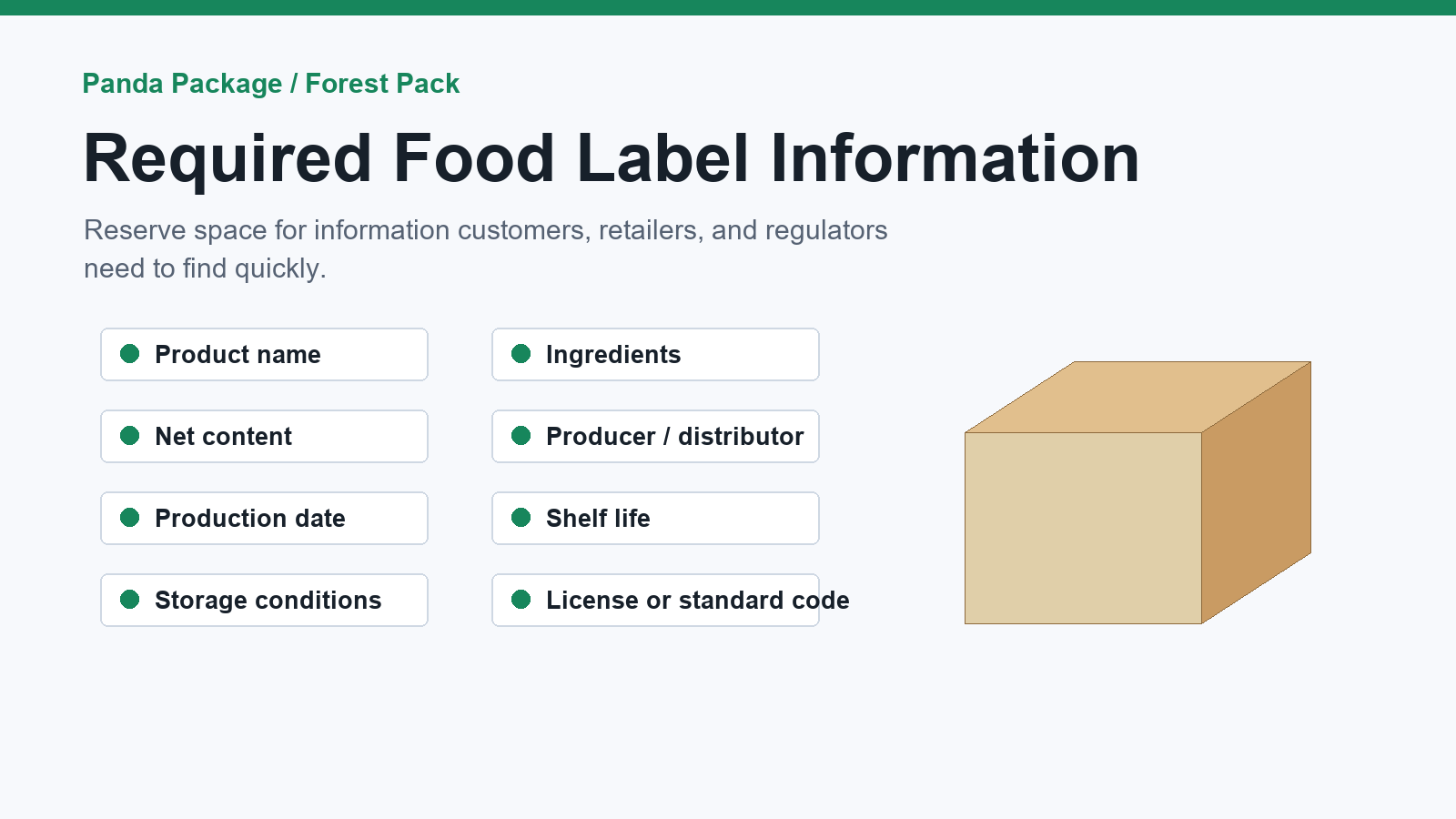
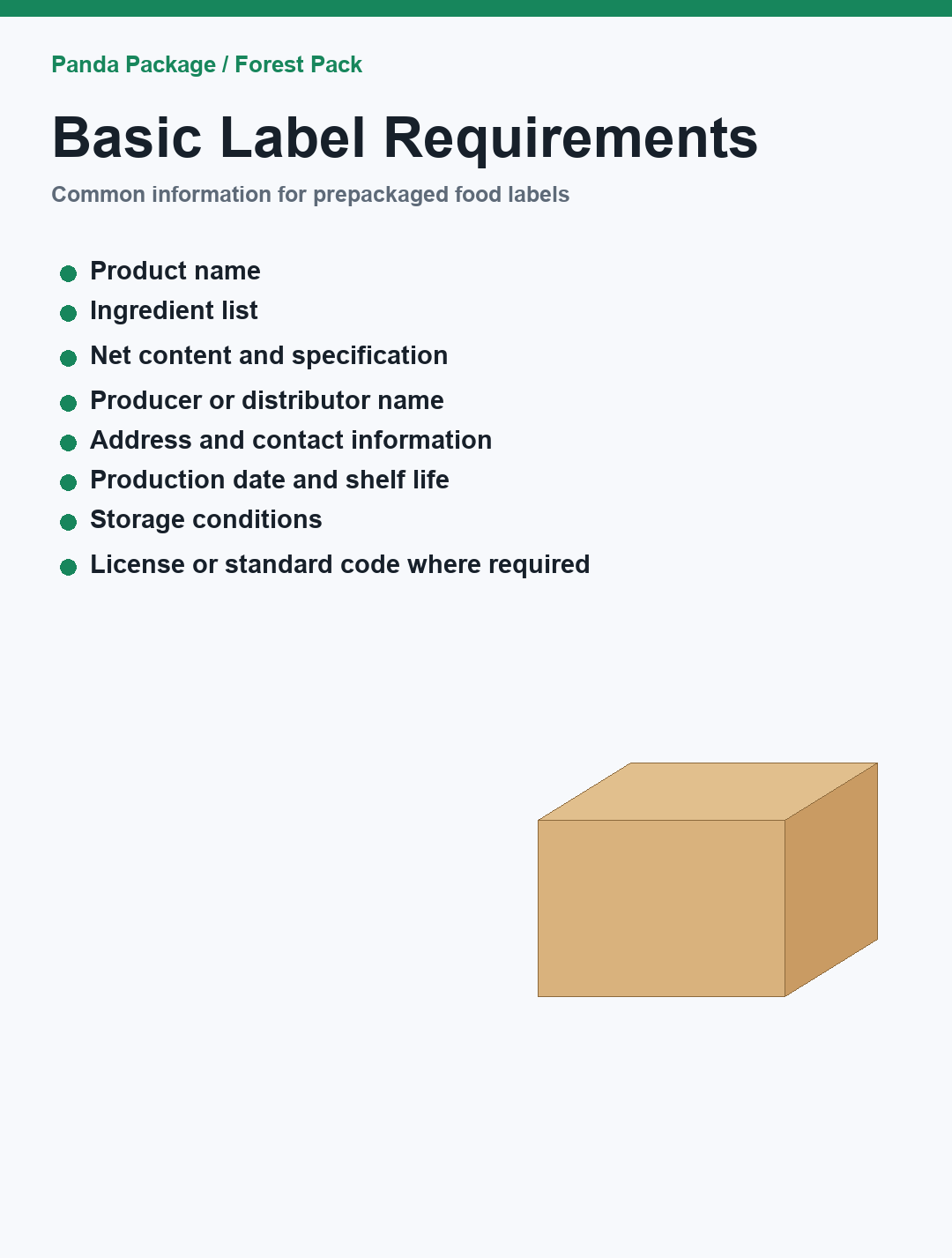
A food label should make key information easy to find: product name, ingredient list, net content, manufacturer or distributor information, production date, shelf life, storage conditions, and other market-specific details.
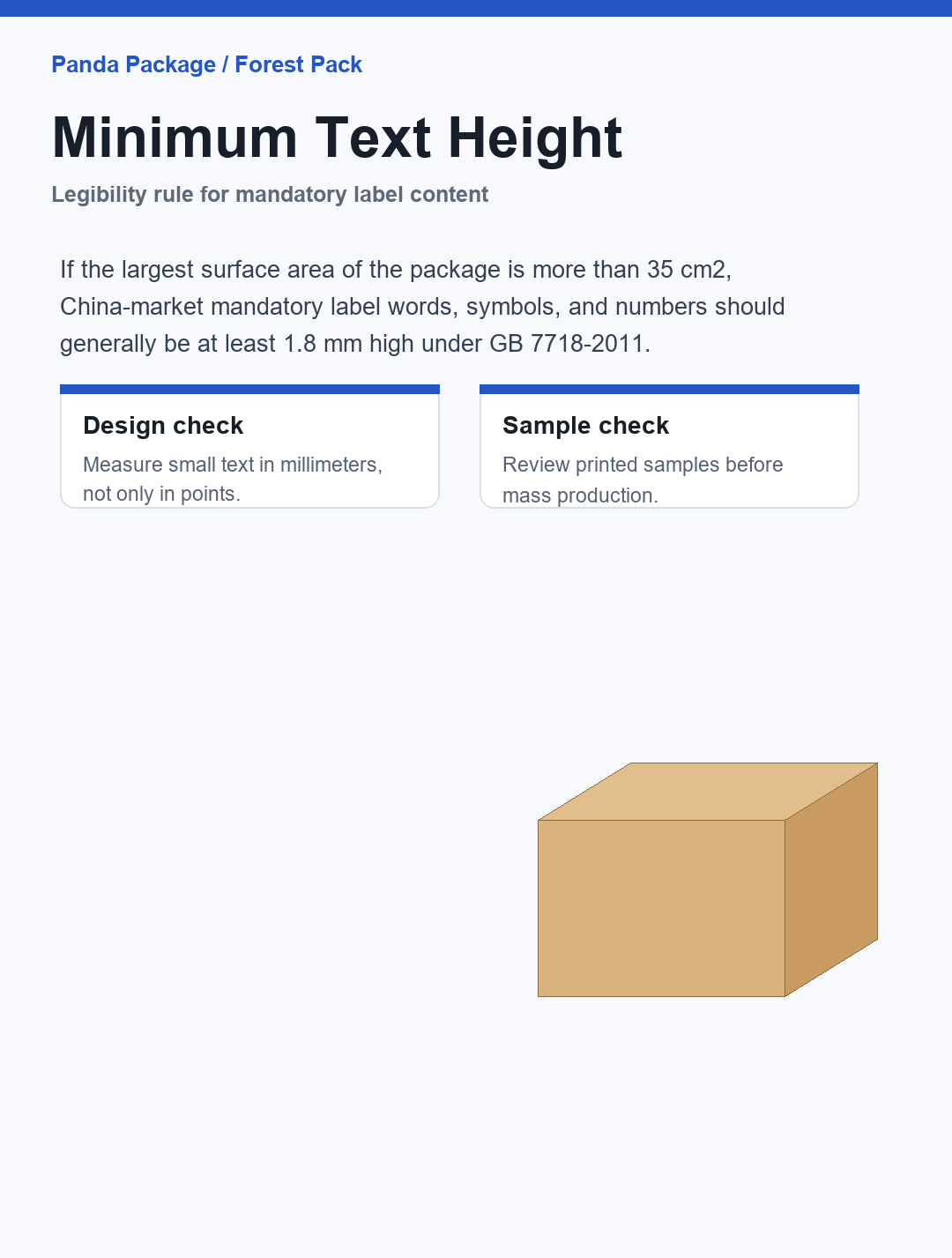
For China-market labels, mandatory label words, symbols, and numbers should generally be at least 1.8 mm high when the largest package surface is more than 35 cm2. For every market, the design principle is the same: customers must be able to read the required information.
The original article visuals were remade in English so international readers can scan the information quickly.
2. Net Content
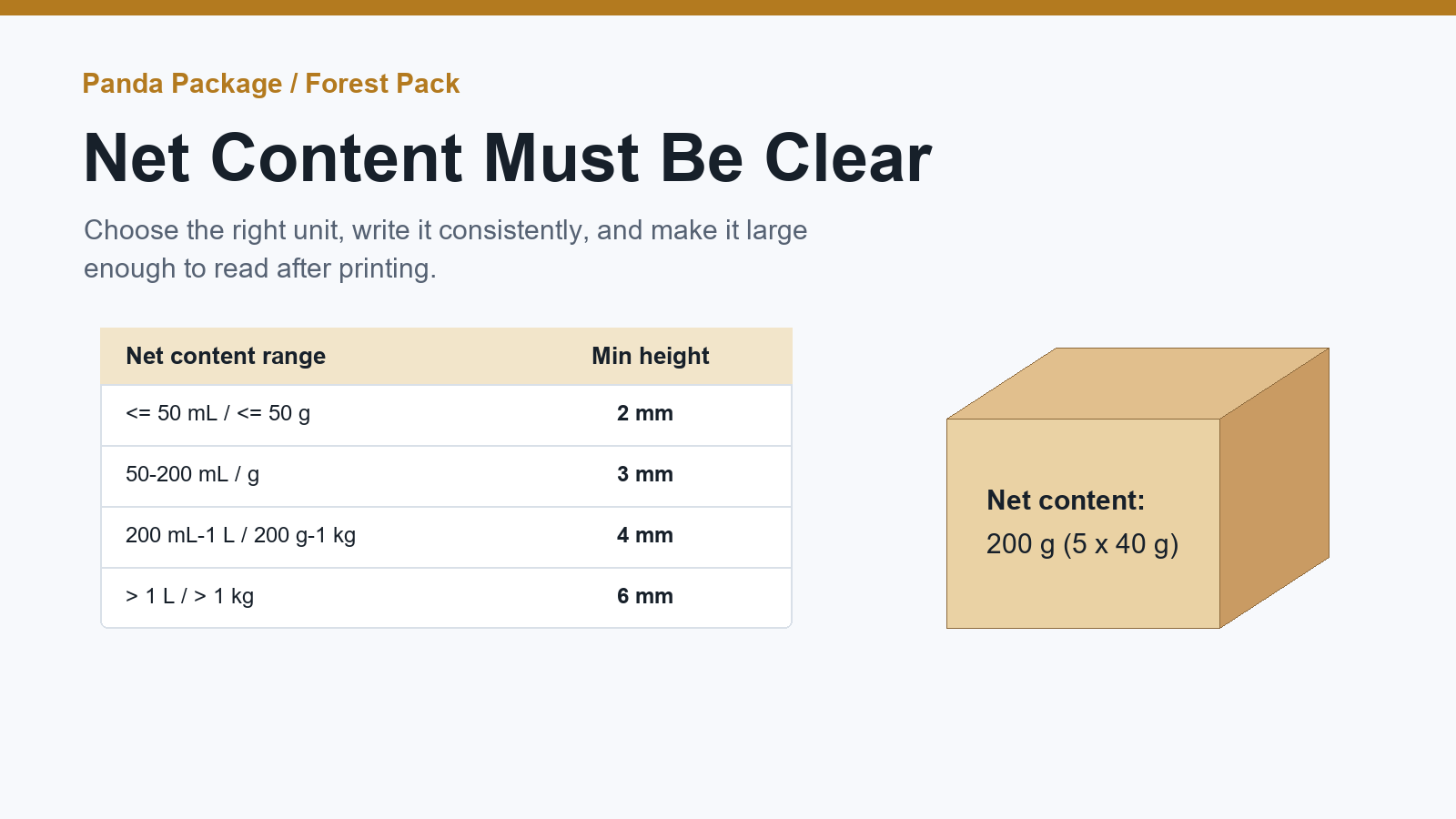
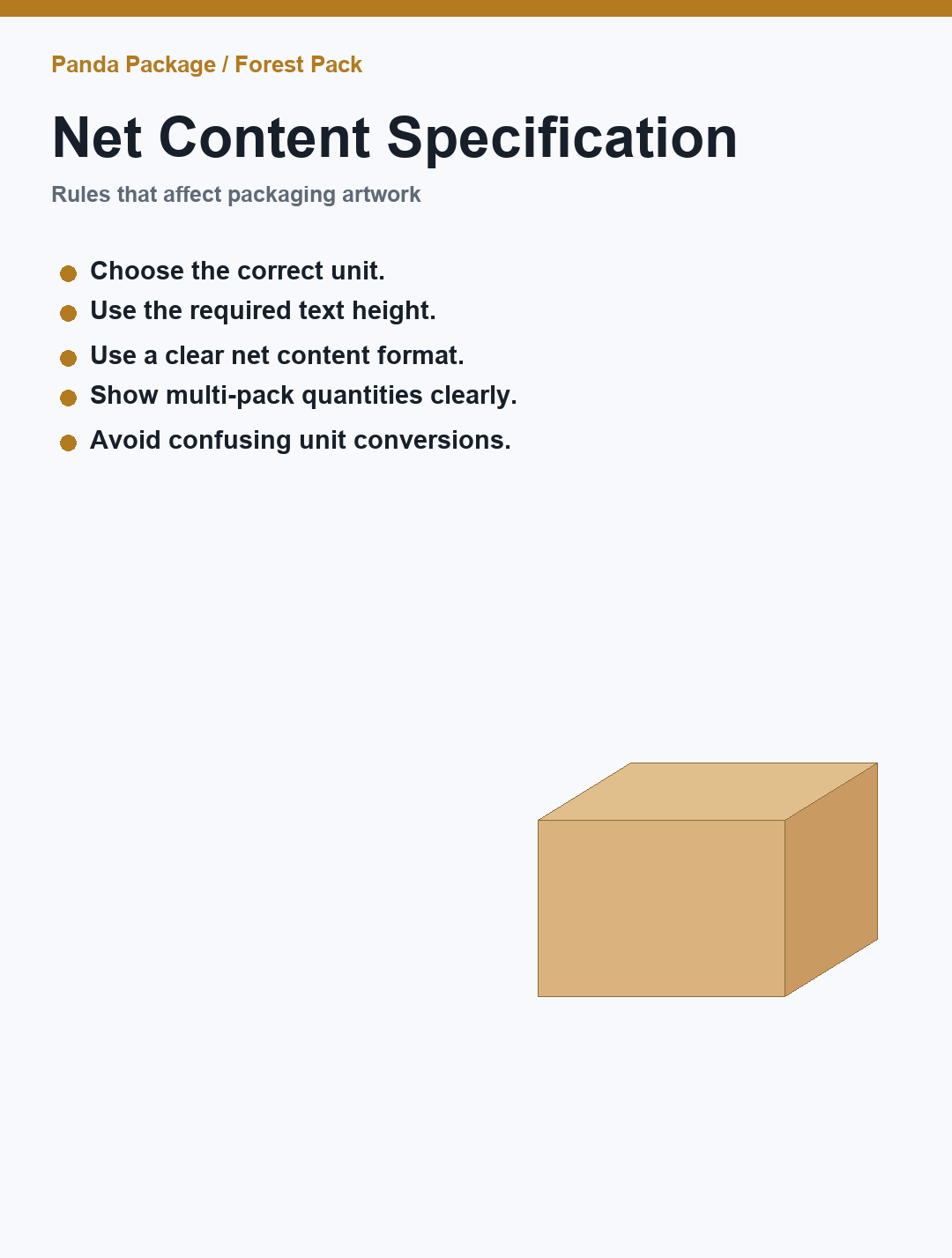
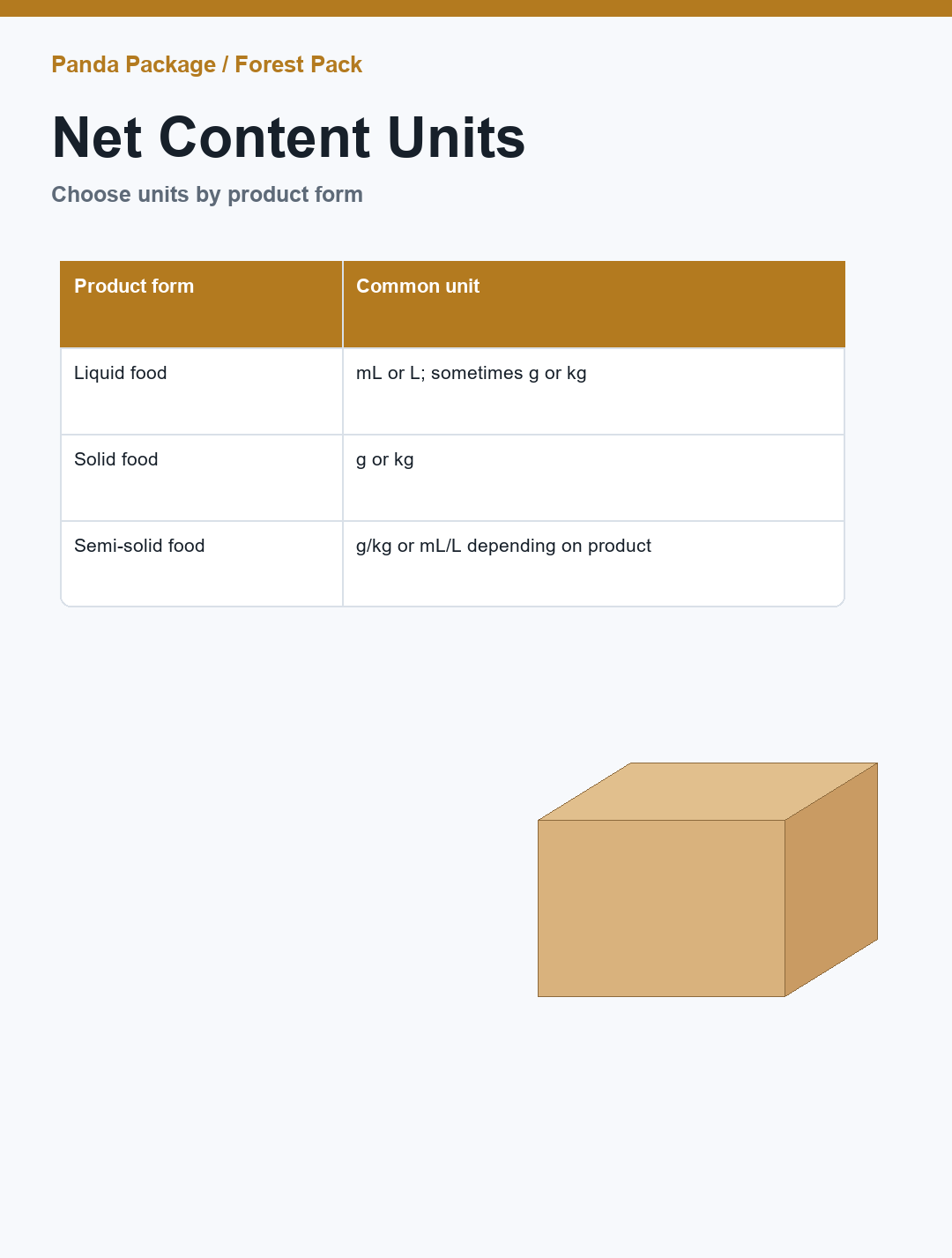
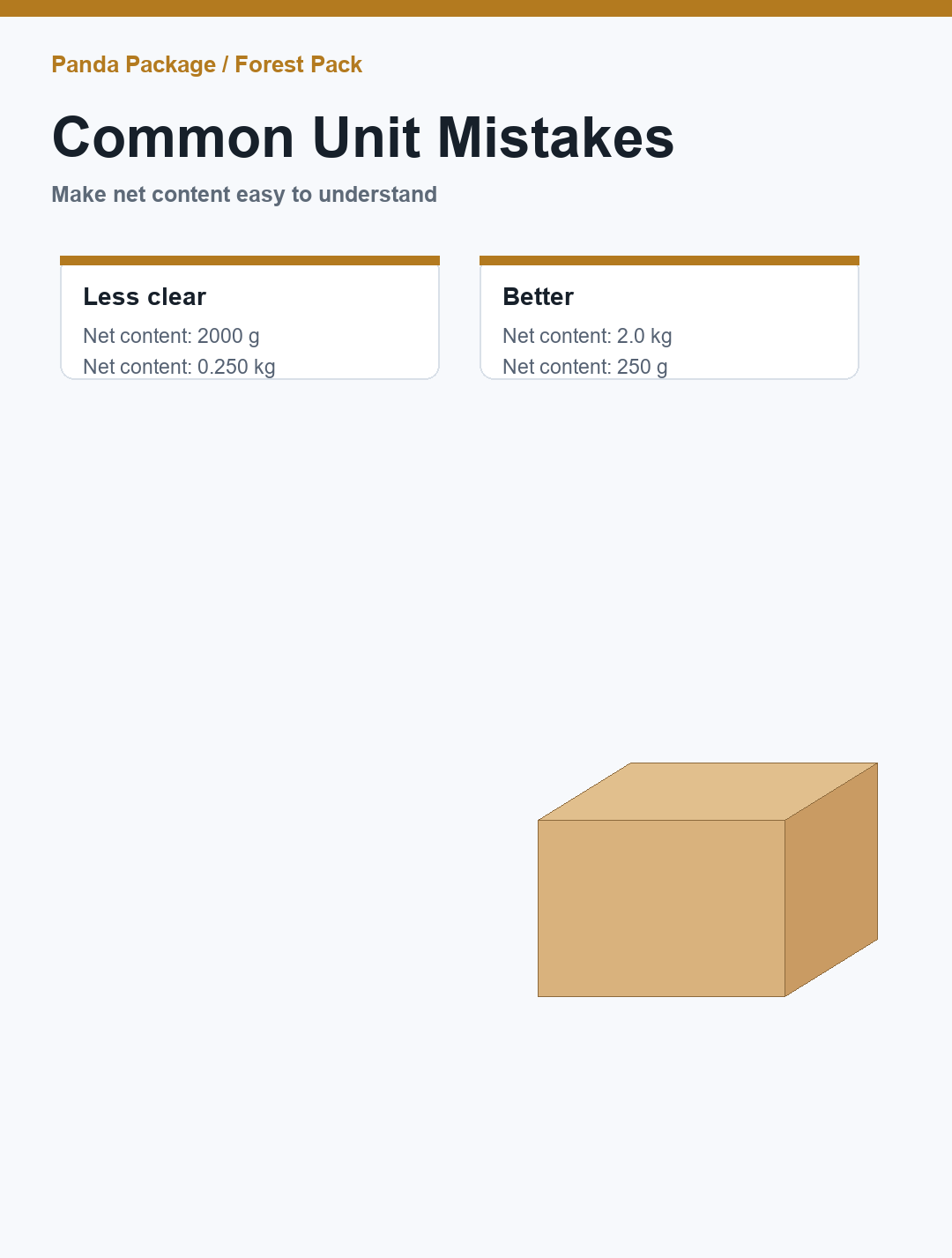
Net content is often small, but it is one of the most important details in food packaging artwork. Use legal units and write them consistently. Solid foods usually use g or kg, liquids often use mL or L, and semi-solid foods may use mass or volume depending on the product and market.
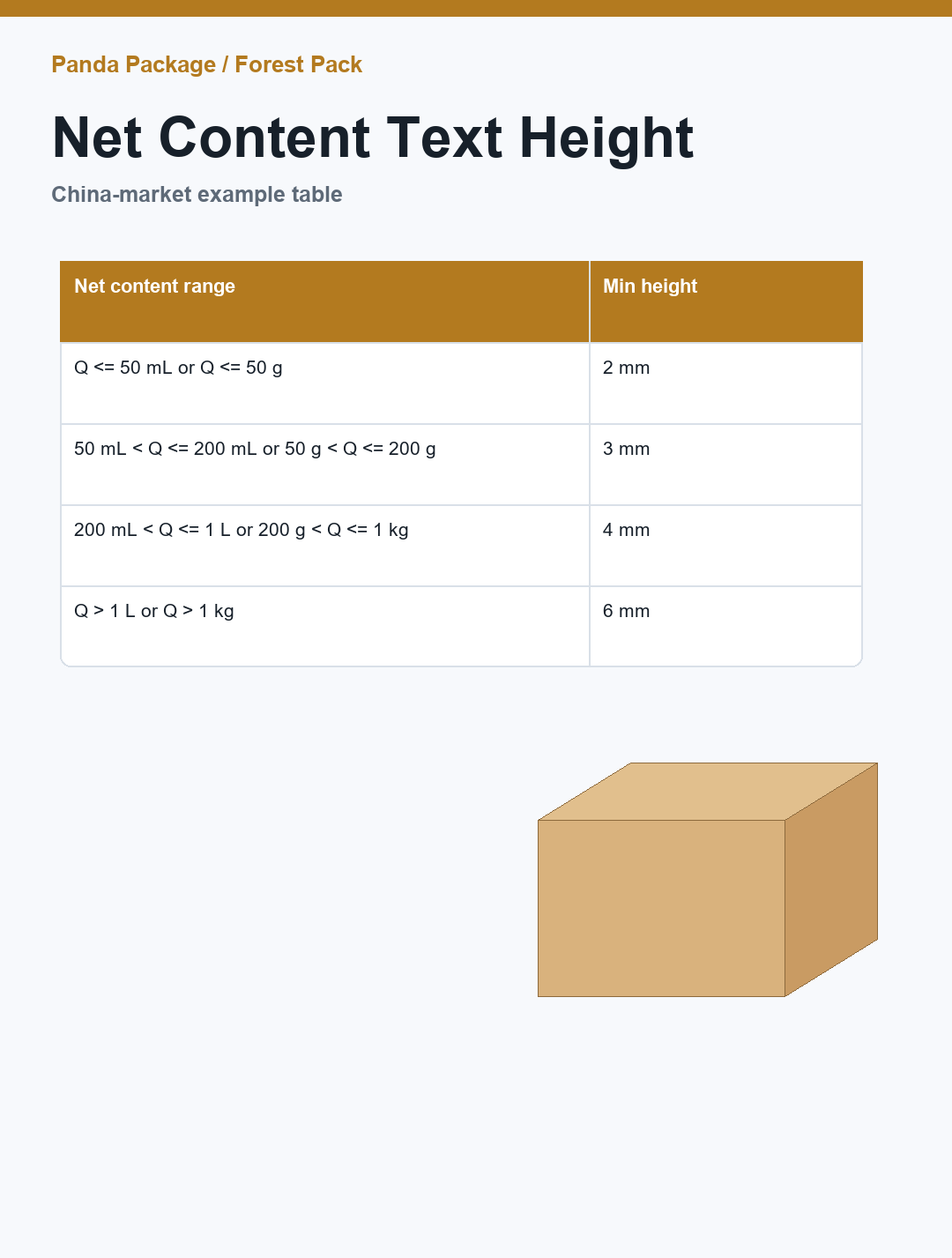
| Net Content Range | Minimum Character Height Example |
|---|---|
| Q <= 50 mL or Q <= 50 g | 2 mm |
| 50 mL < Q <= 200 mL or 50 g < Q <= 200 g | 3 mm |
| 200 mL < Q <= 1 L or 200 g < Q <= 1 kg | 4 mm |
| Q > 1 L or Q > 1 kg | 6 mm |
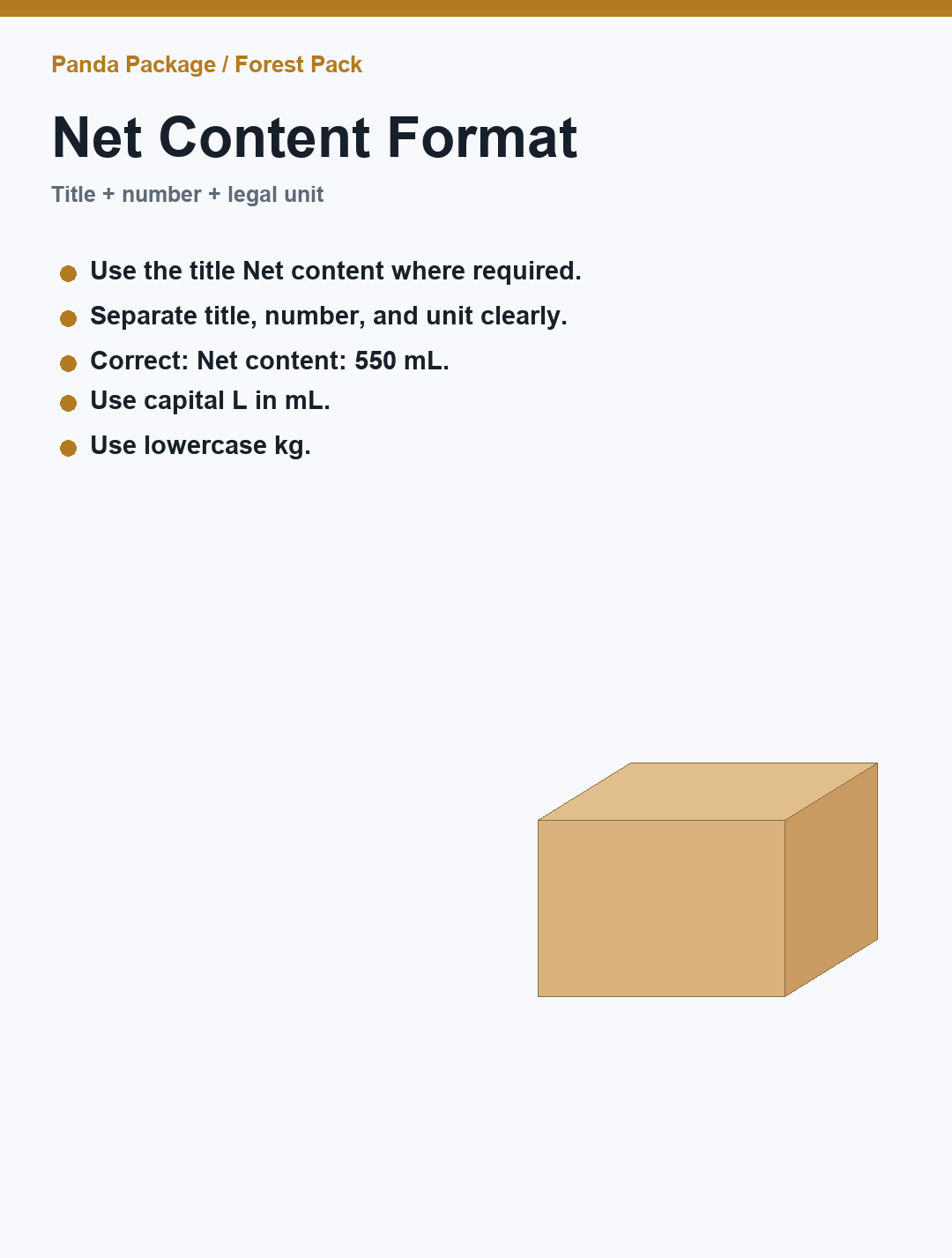
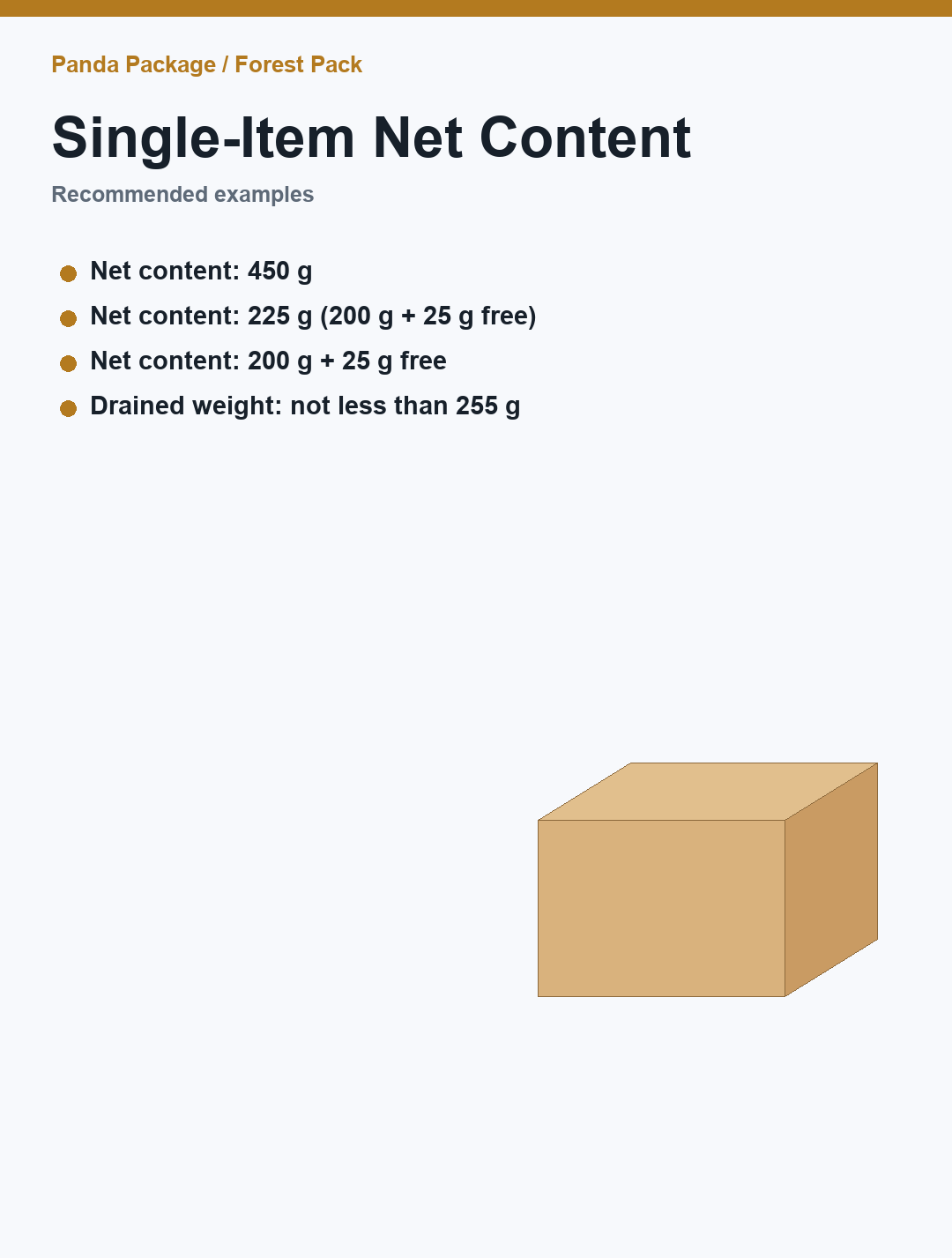
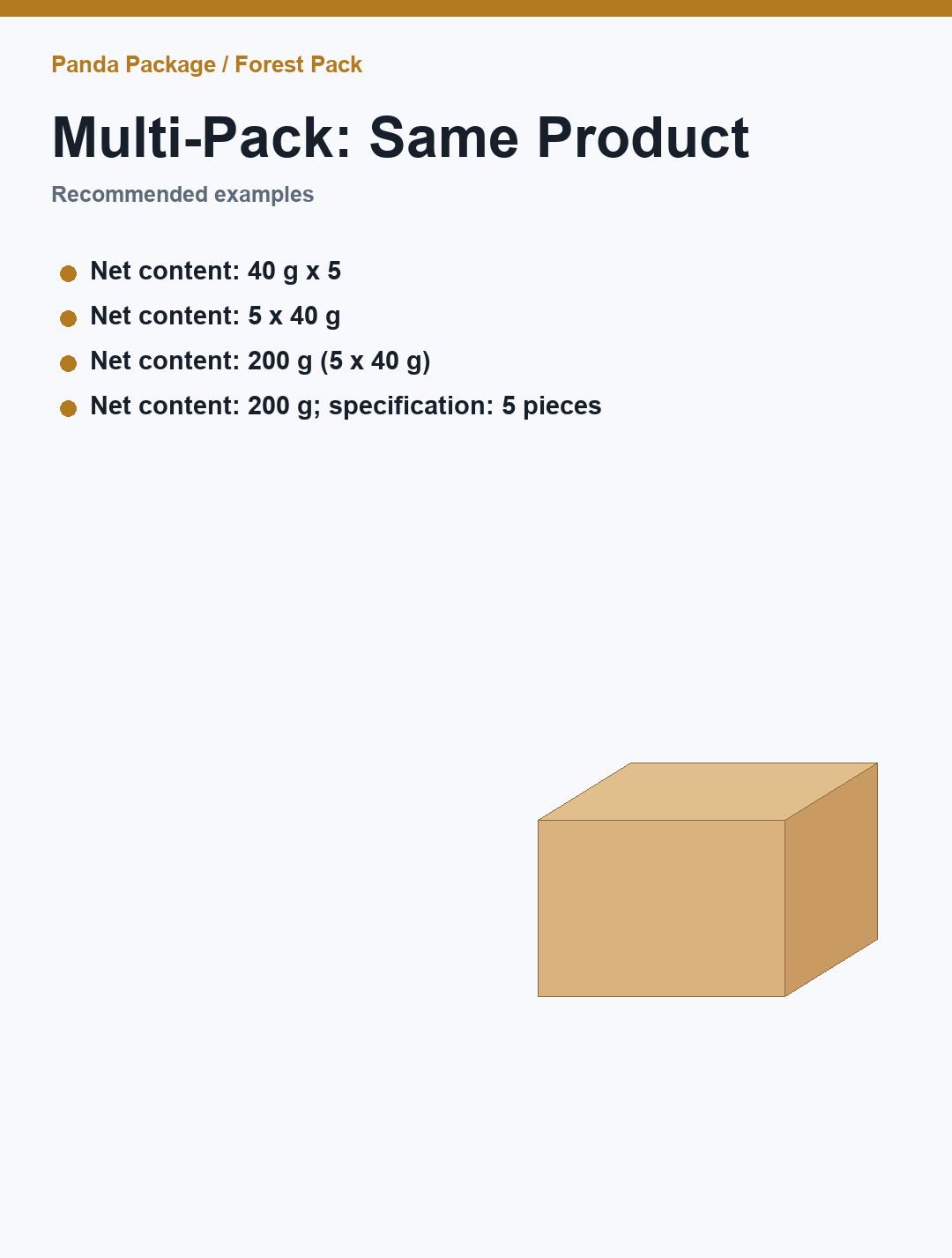
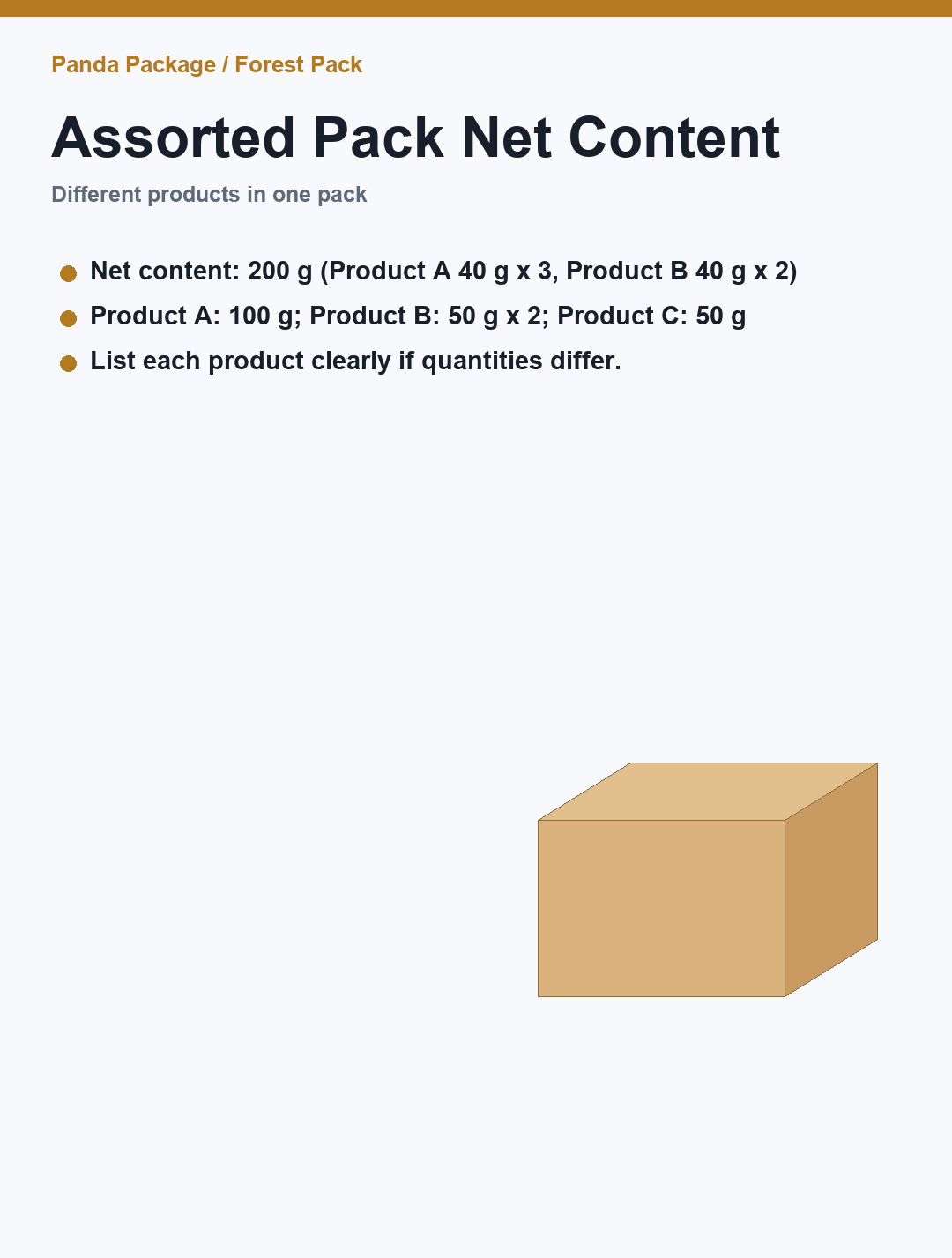
Useful examples include Net content: 450 g, Net content: 40 g x 5, and Net content: 200 g (5 x 40 g).
Net-content examples are shown as clean English reference graphics for easier customer education.
3. Date And Storage Statements
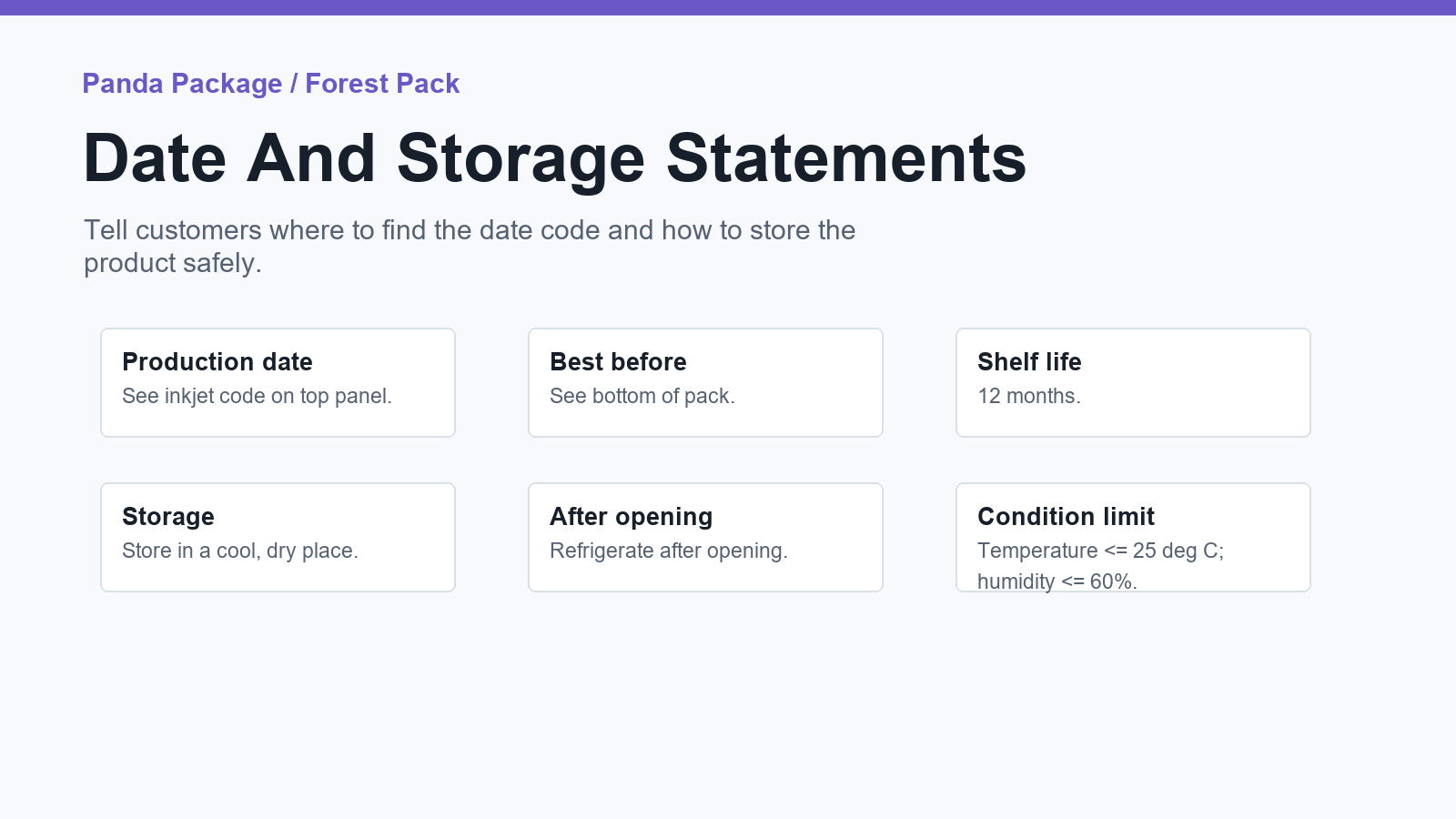
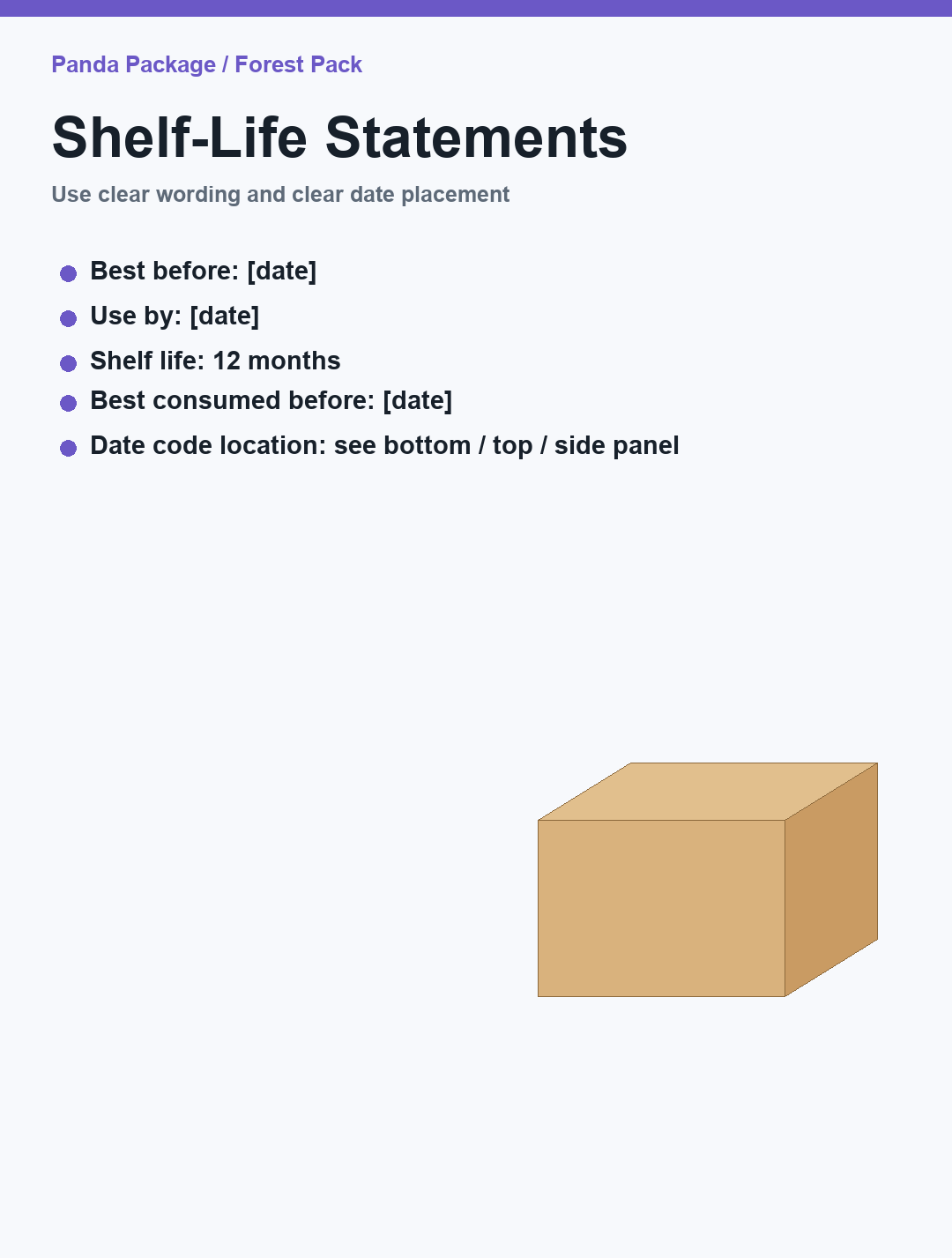
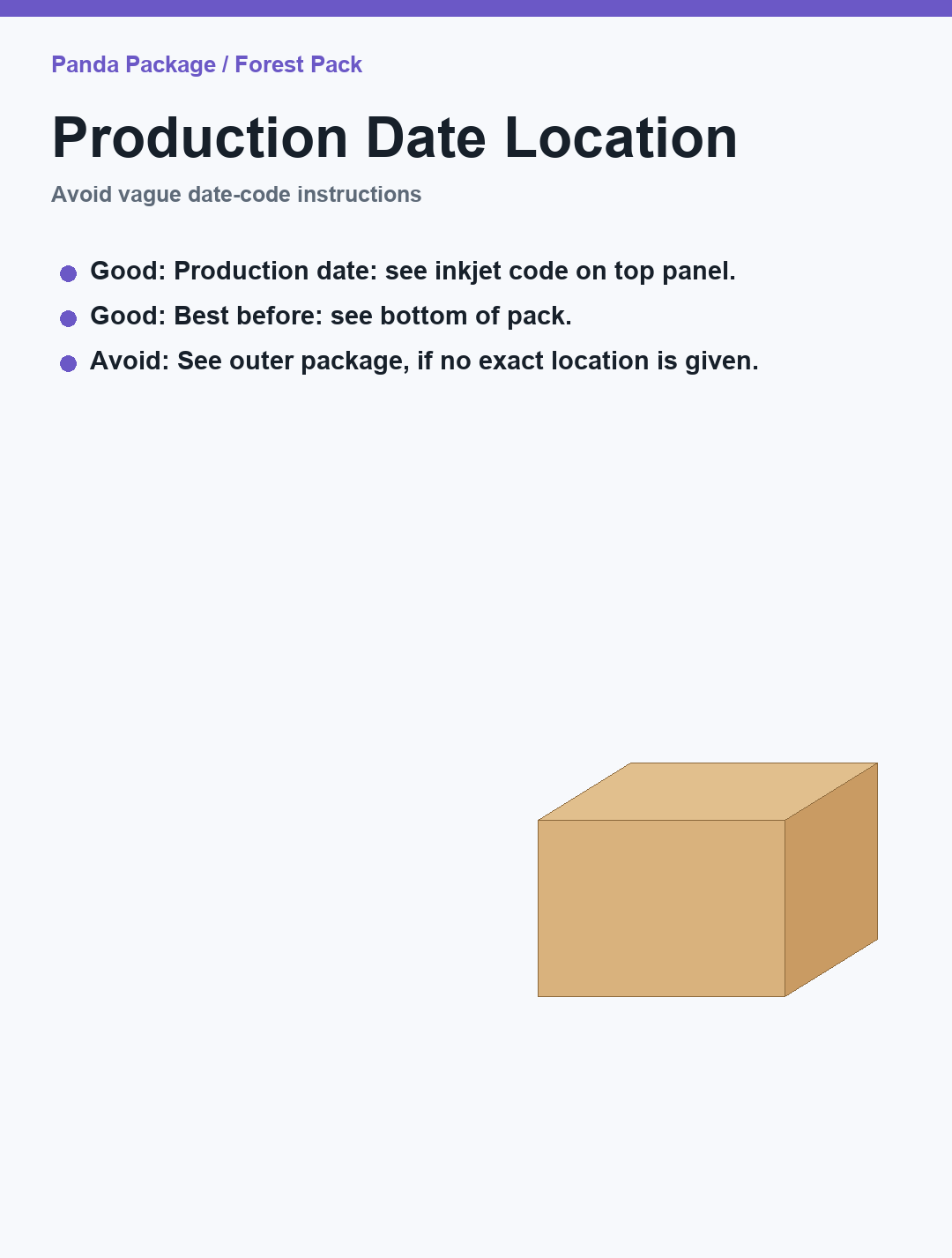
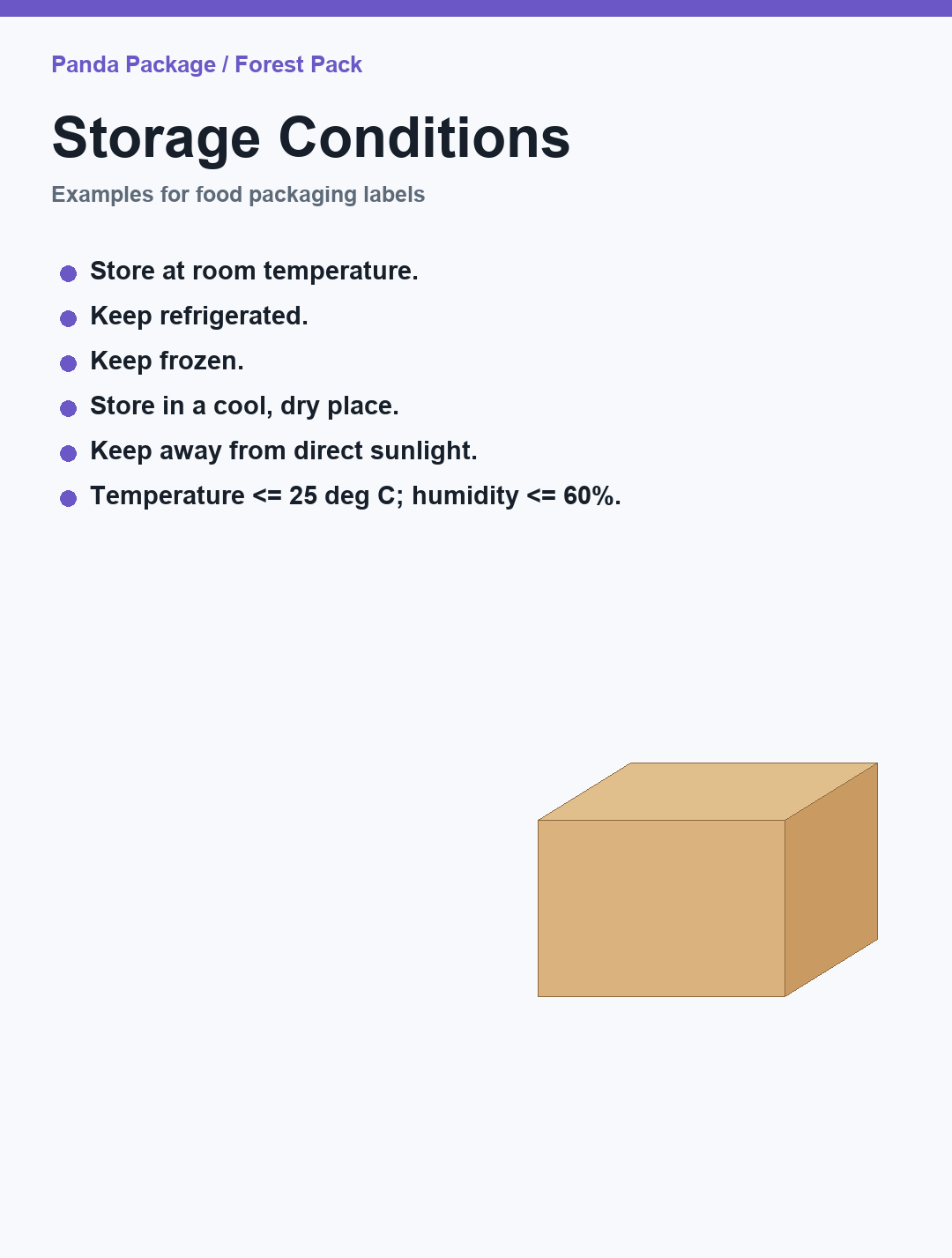
Date and shelf-life information should be placed in a specific, predictable location. Avoid vague wording if the actual date-code location is not clear. Storage instructions also need to match the product’s real conditions, especially for frozen, refrigerated, humid, or high-temperature environments.
4. Barcode Design
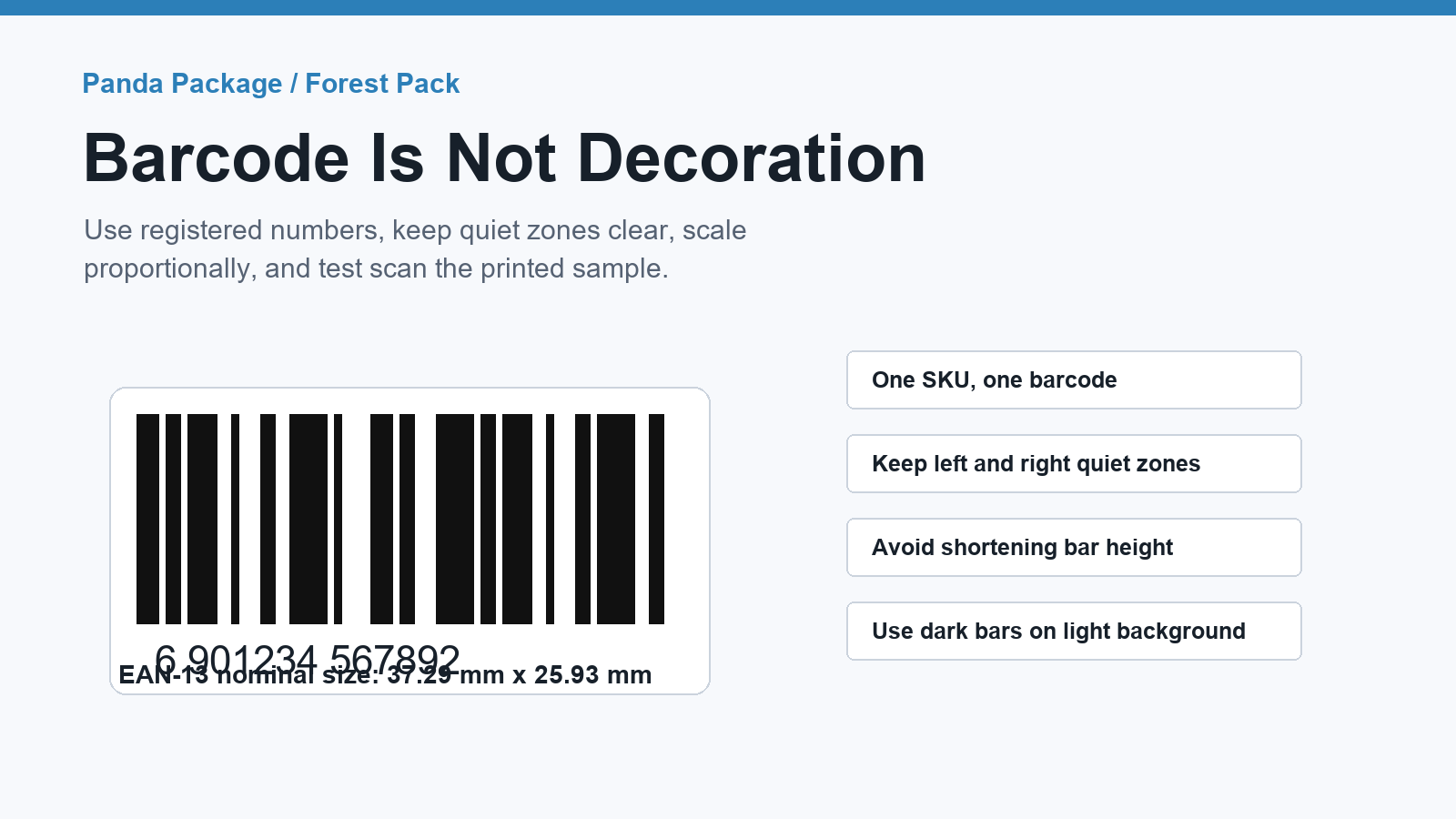
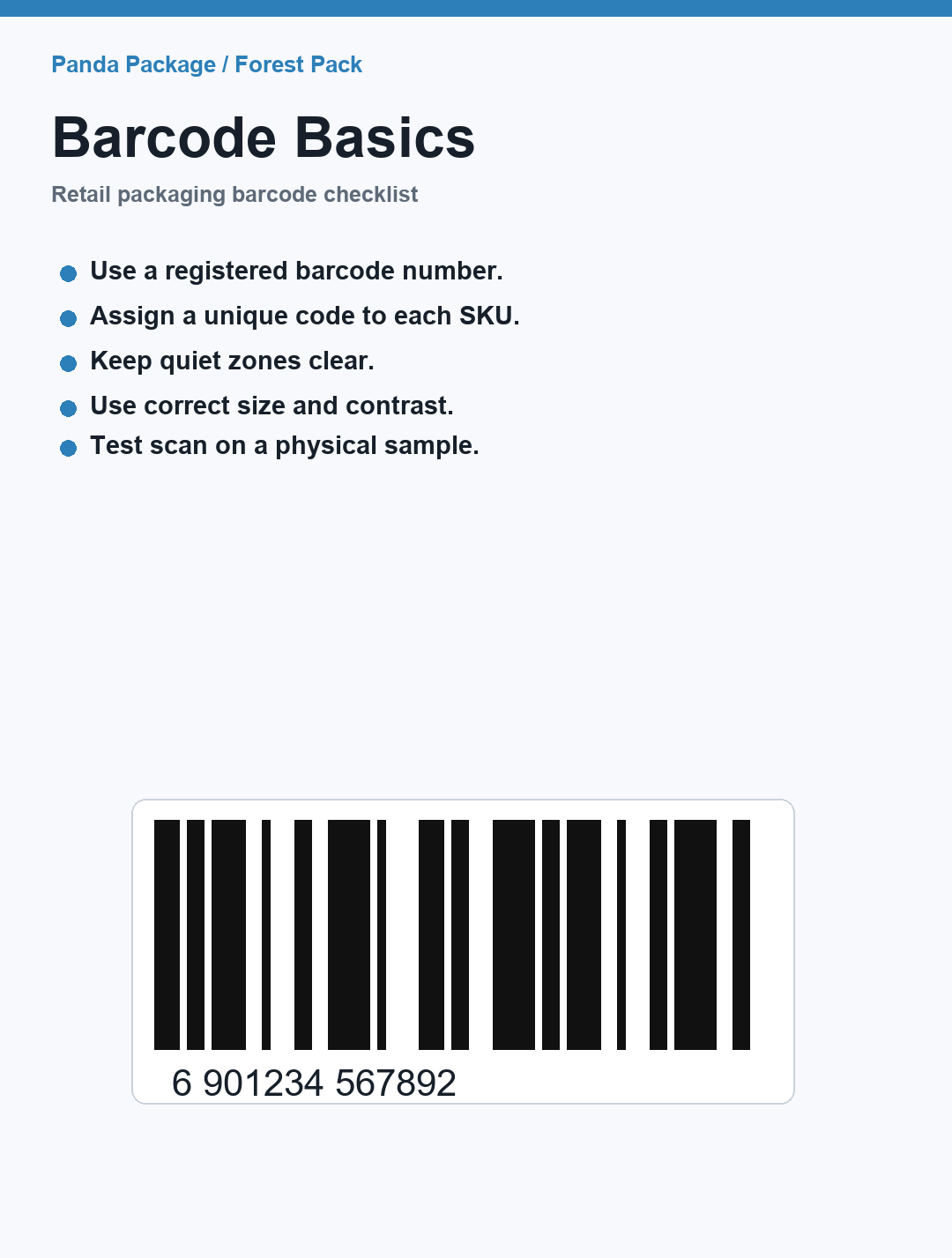
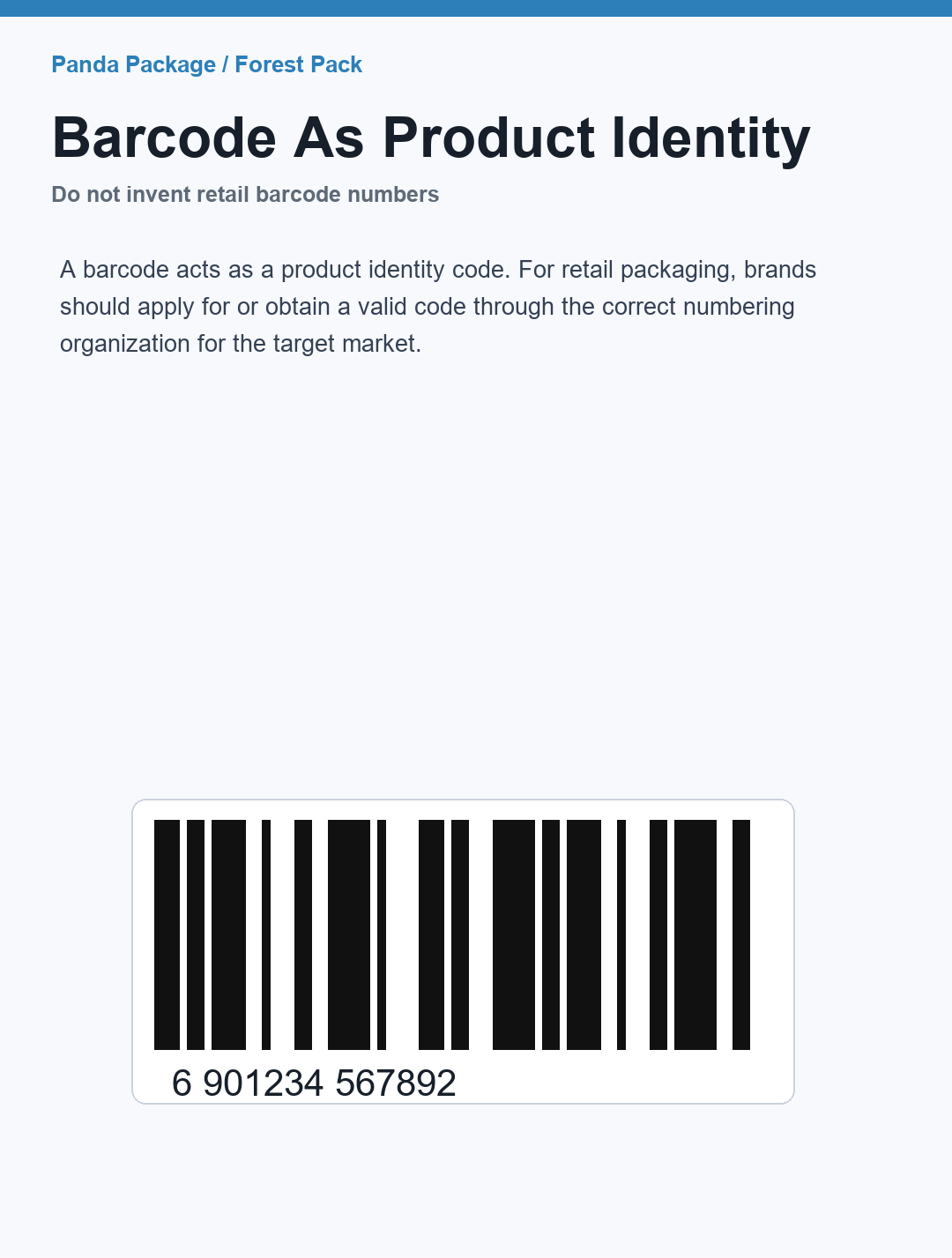
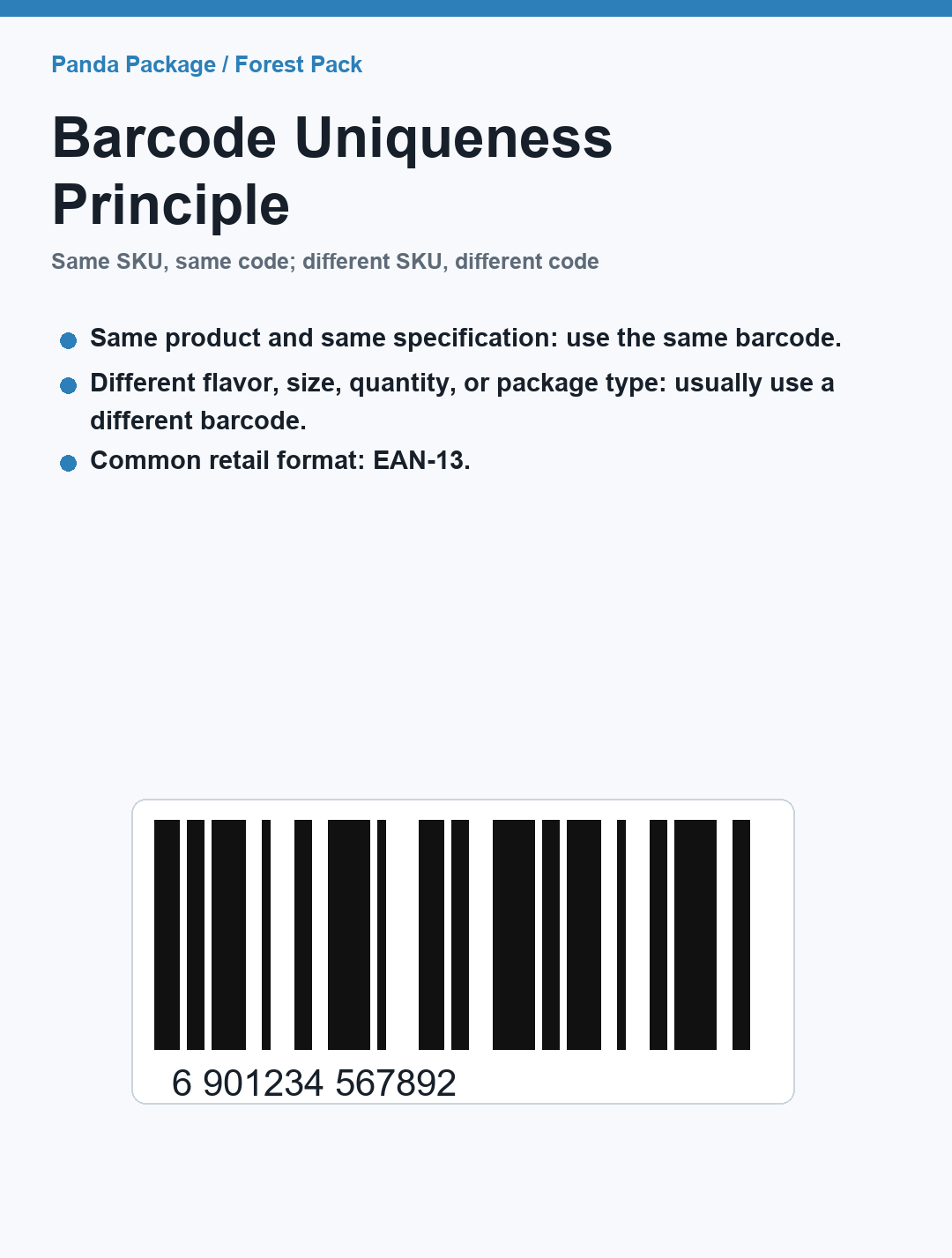
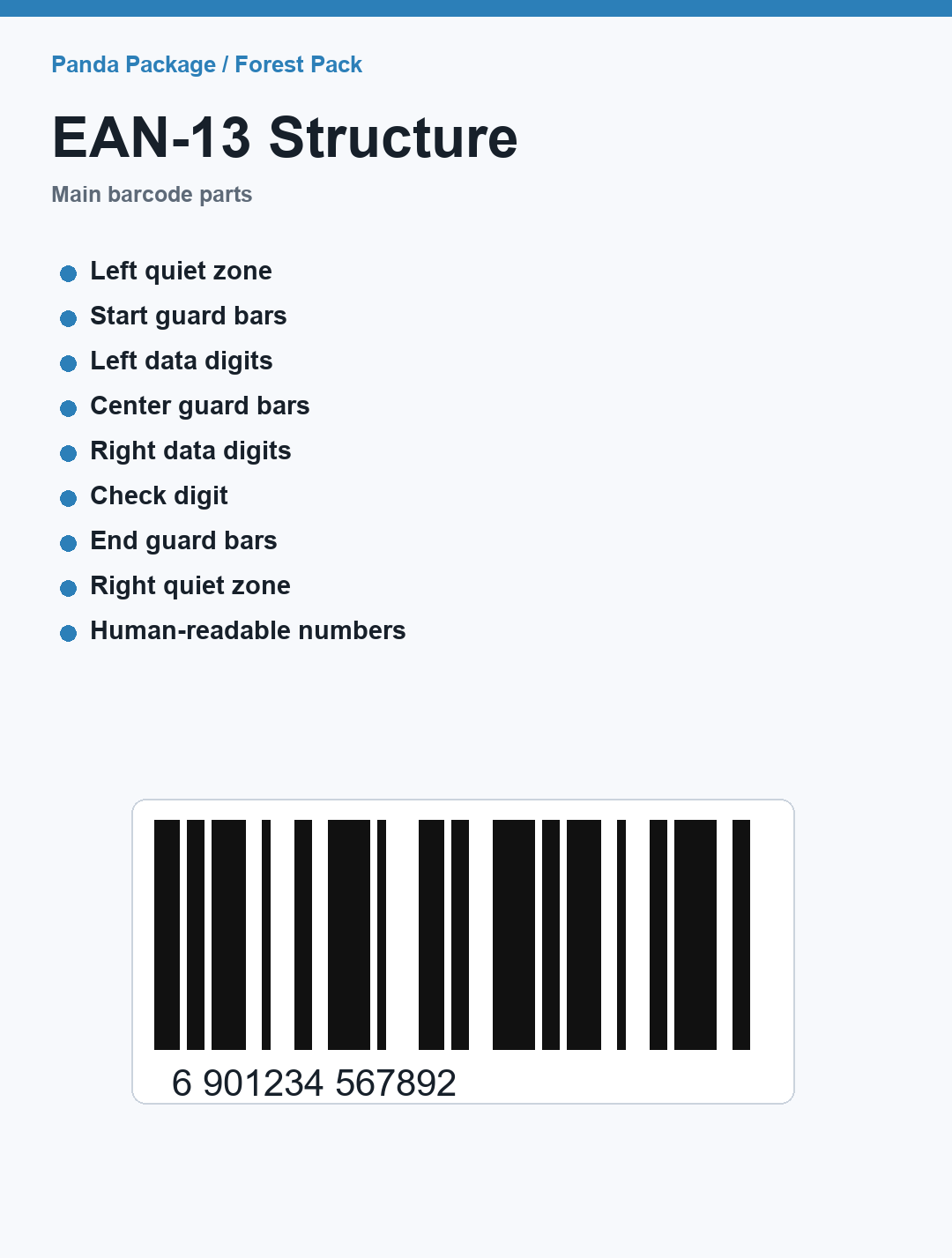
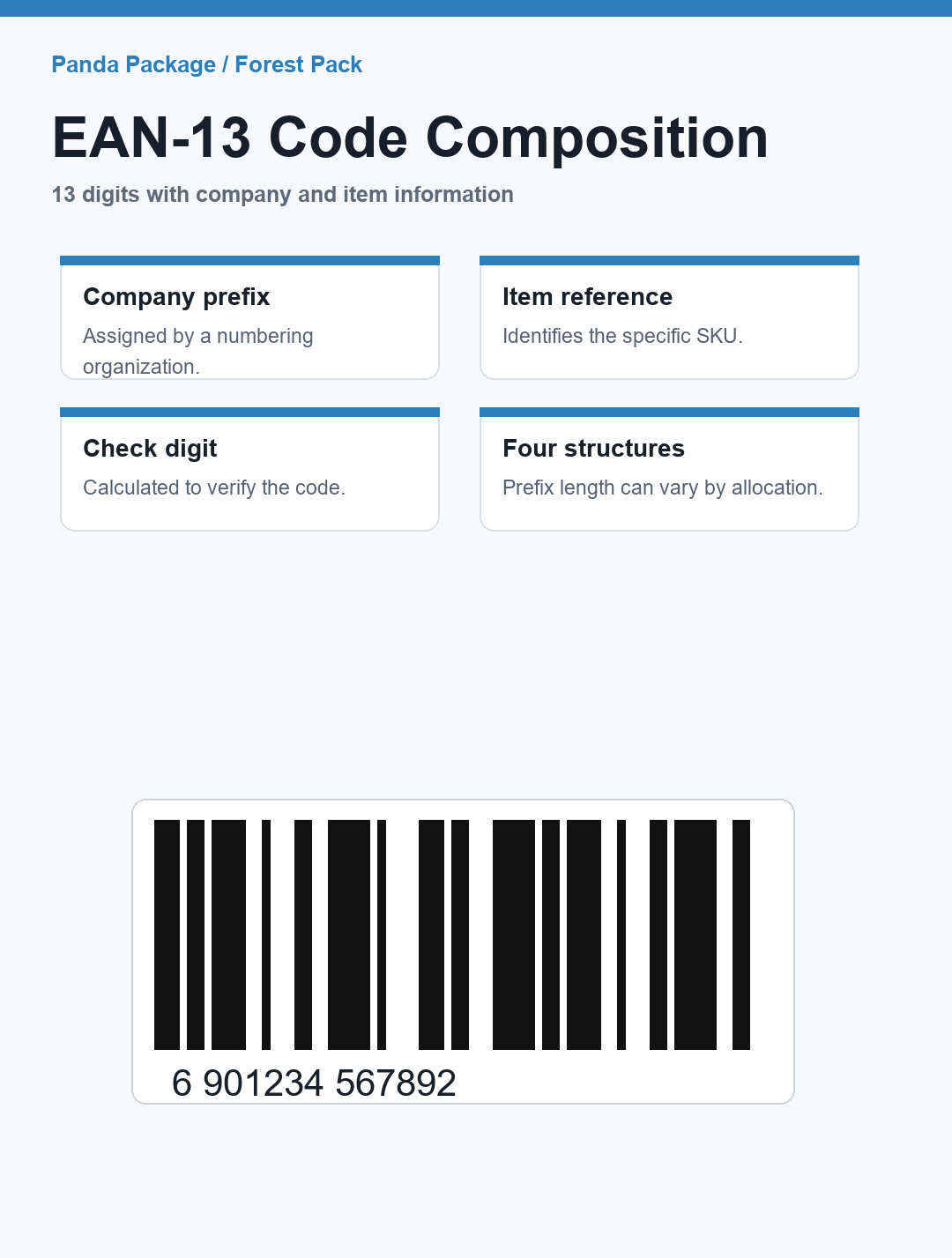
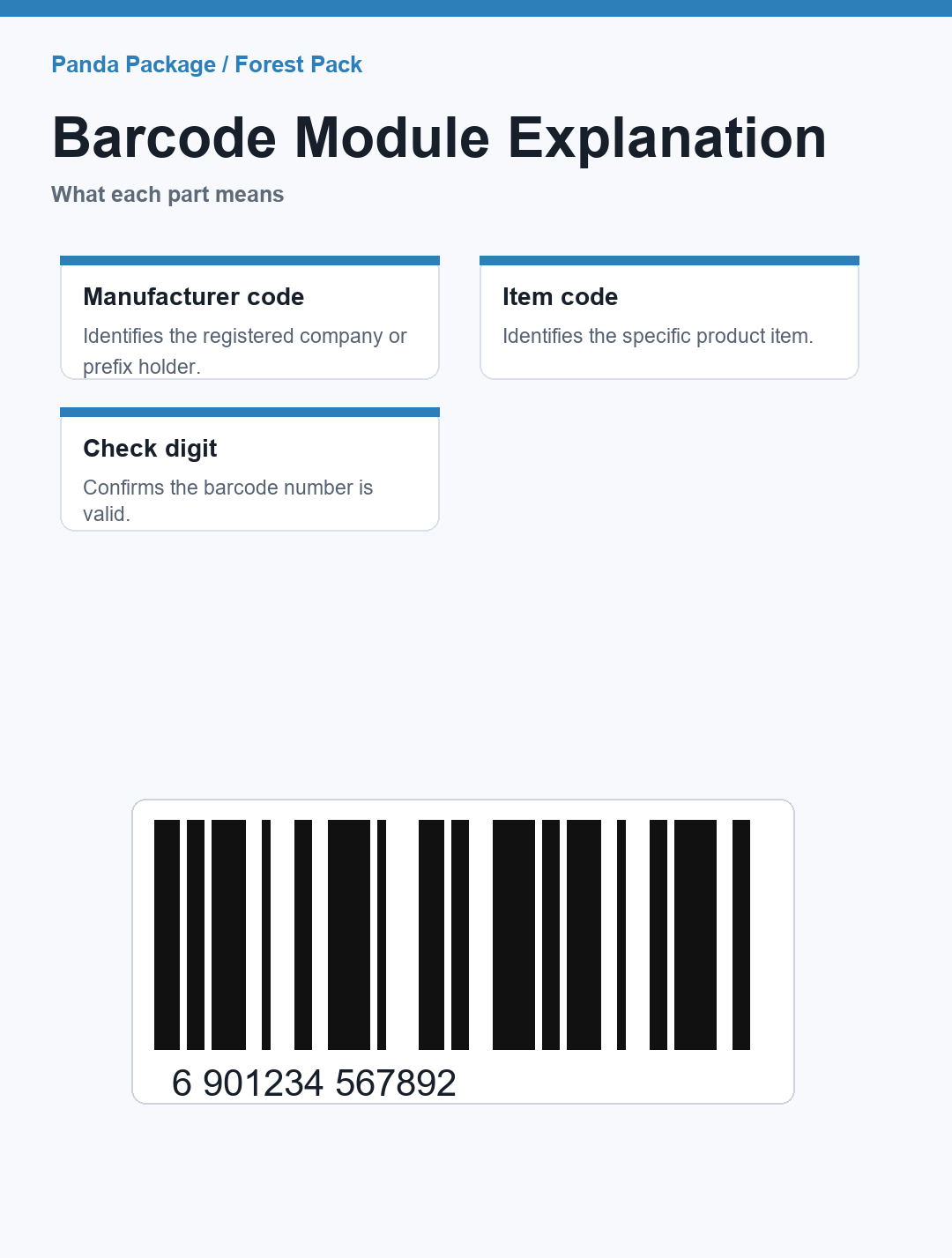
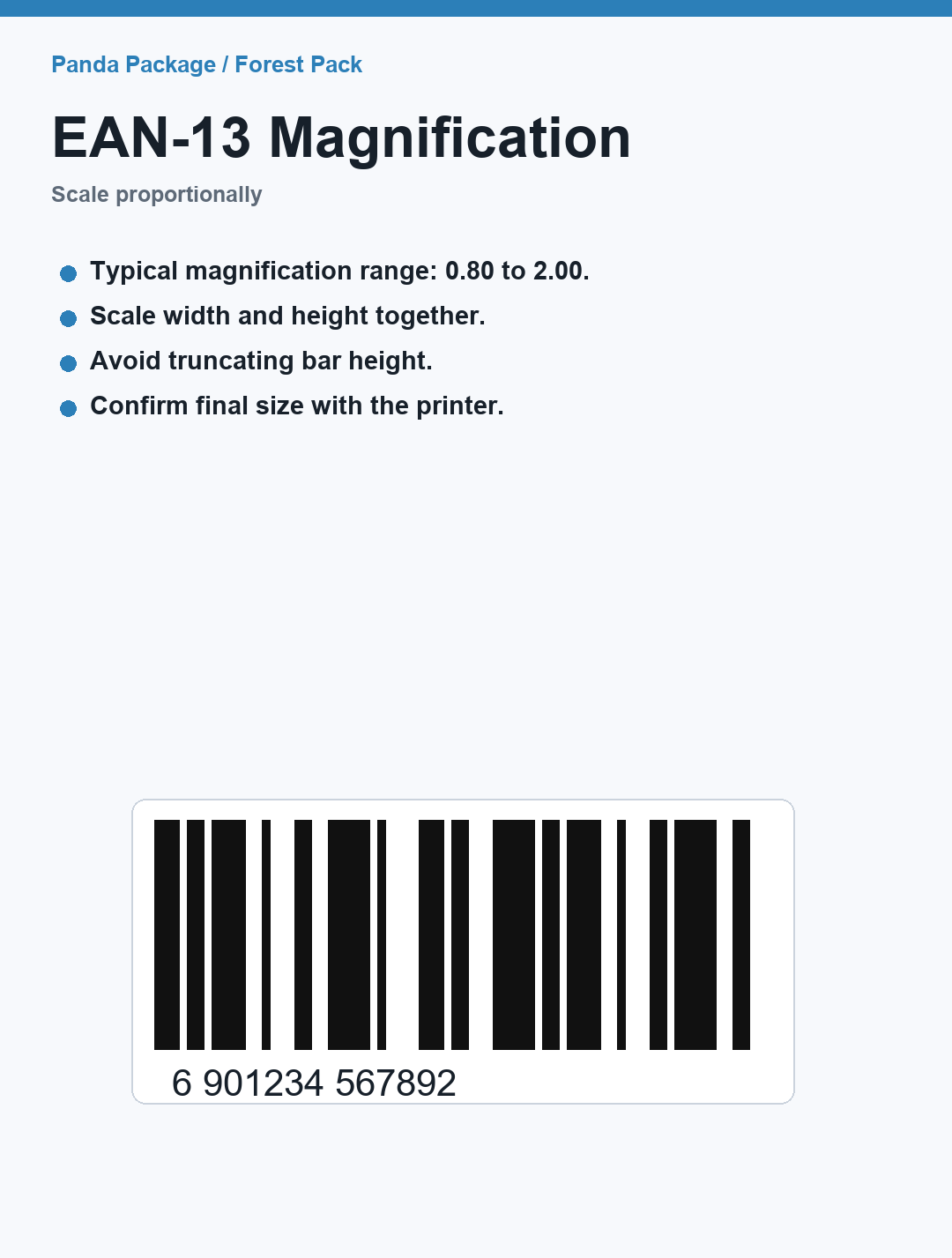
A barcode is a product identifier, not decoration. Use registered numbers, assign different codes to different SKUs, keep quiet zones clear, and test scan the physical sample before mass production.
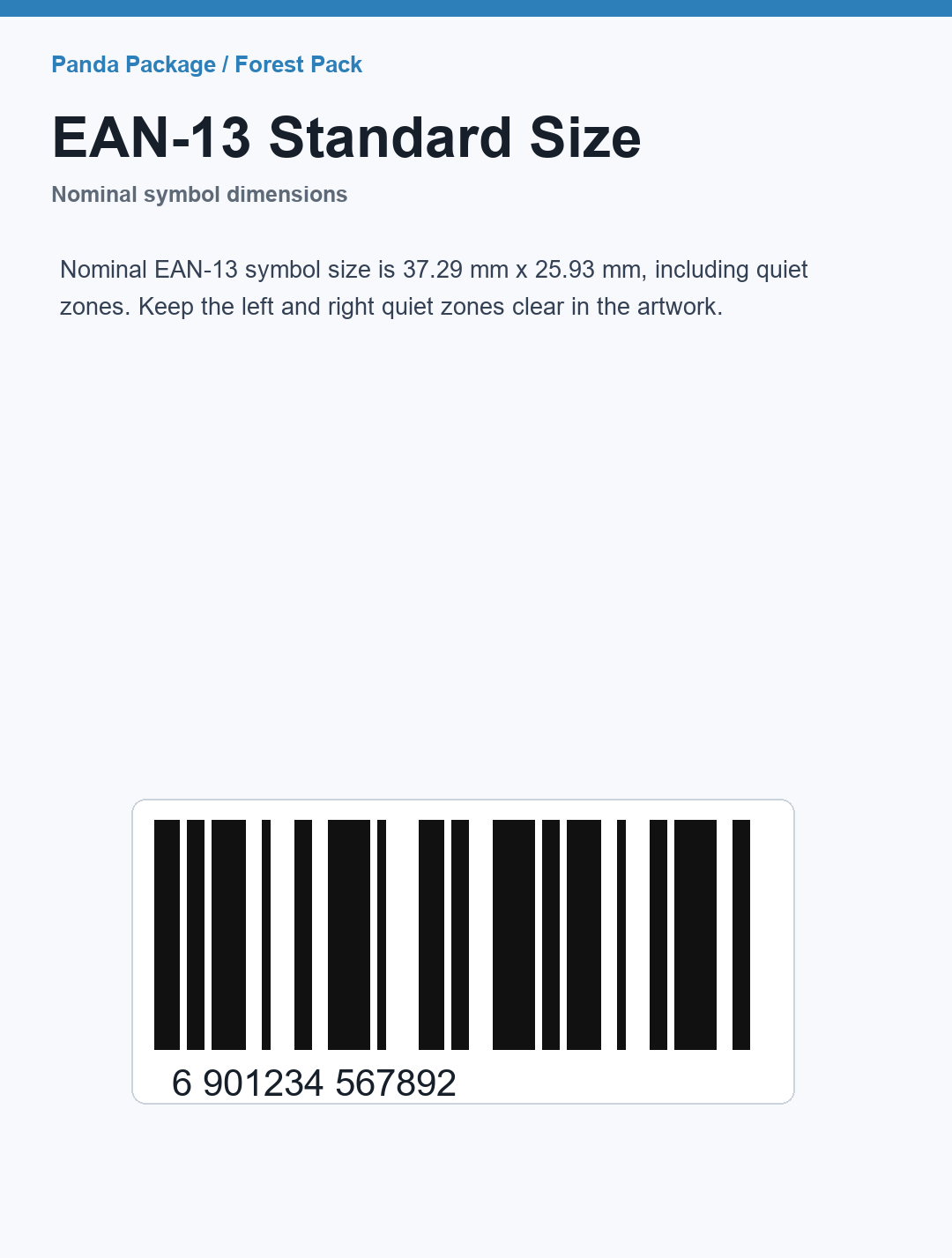
| EAN-13 Item | Practical Reminder |
|---|---|
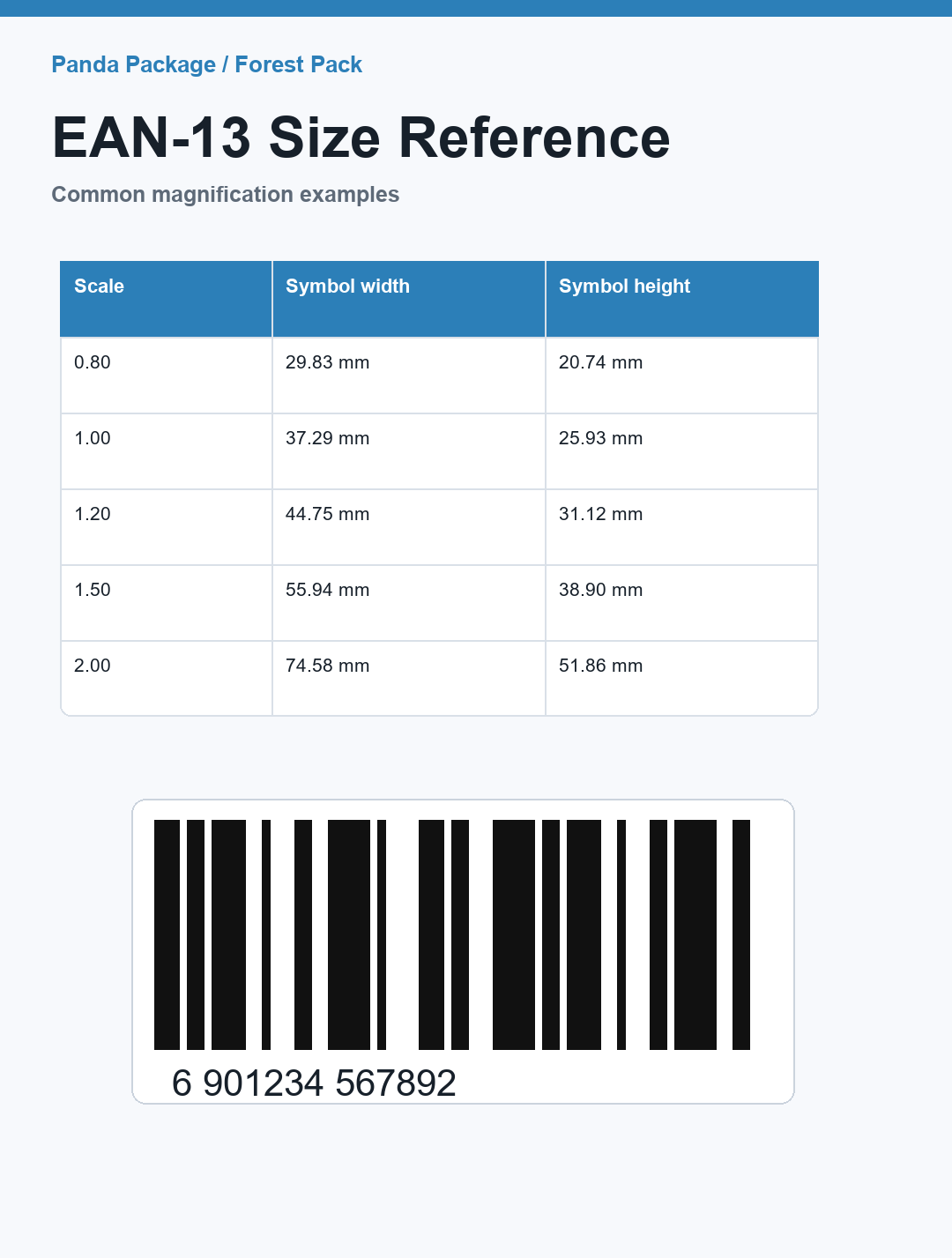
| Nominal size | 37.29 mm x 25.93 mm, including quiet zones |
| Scaling | Scale proportionally within the allowed range |
| Truncation | Avoid cutting barcode height because it can reduce scan performance |
| Color | Dark bars on a light background are usually safest |
Barcode diagrams have been remade in English while keeping the original information structure.
5. Product Name And Claims
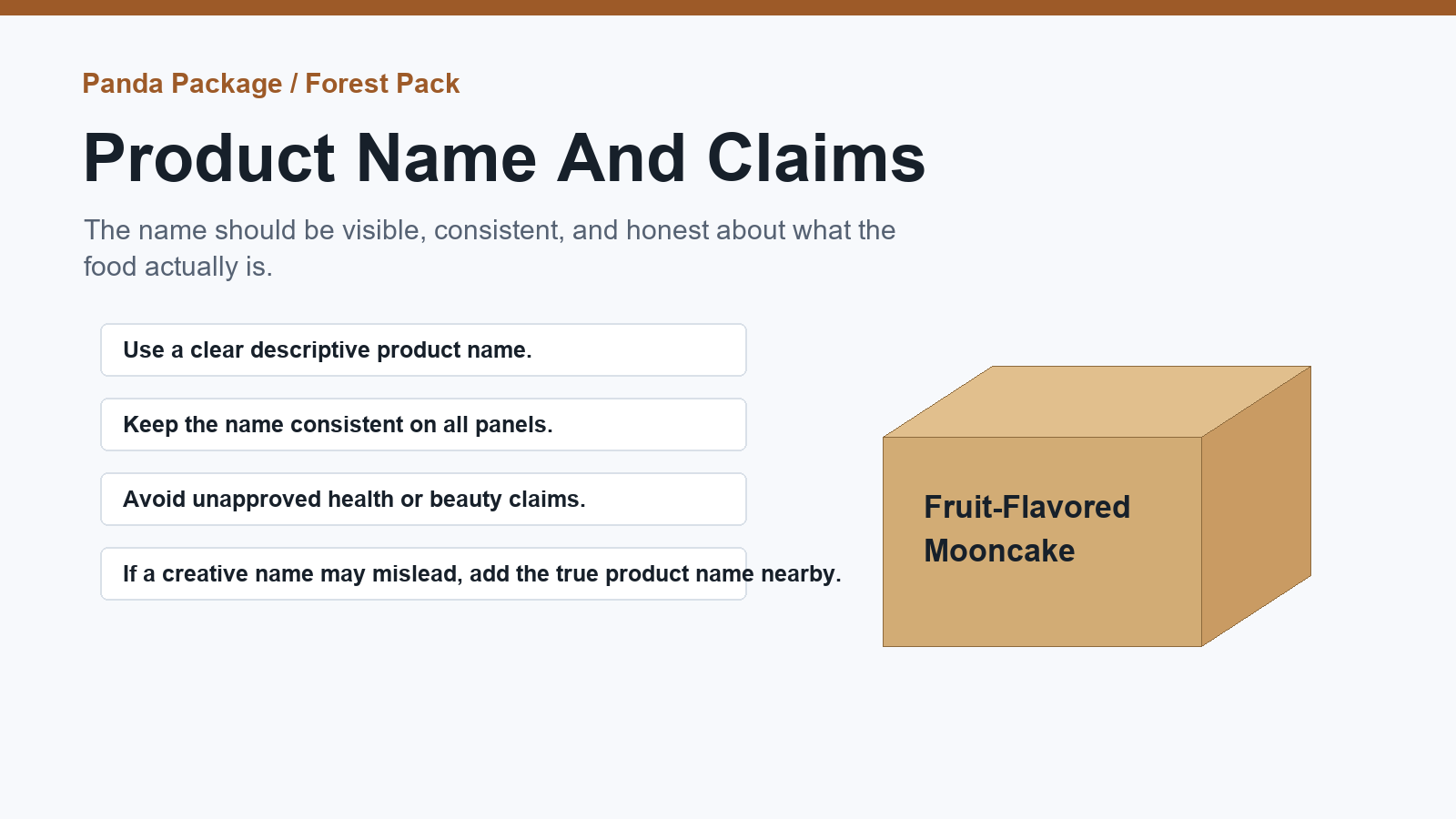
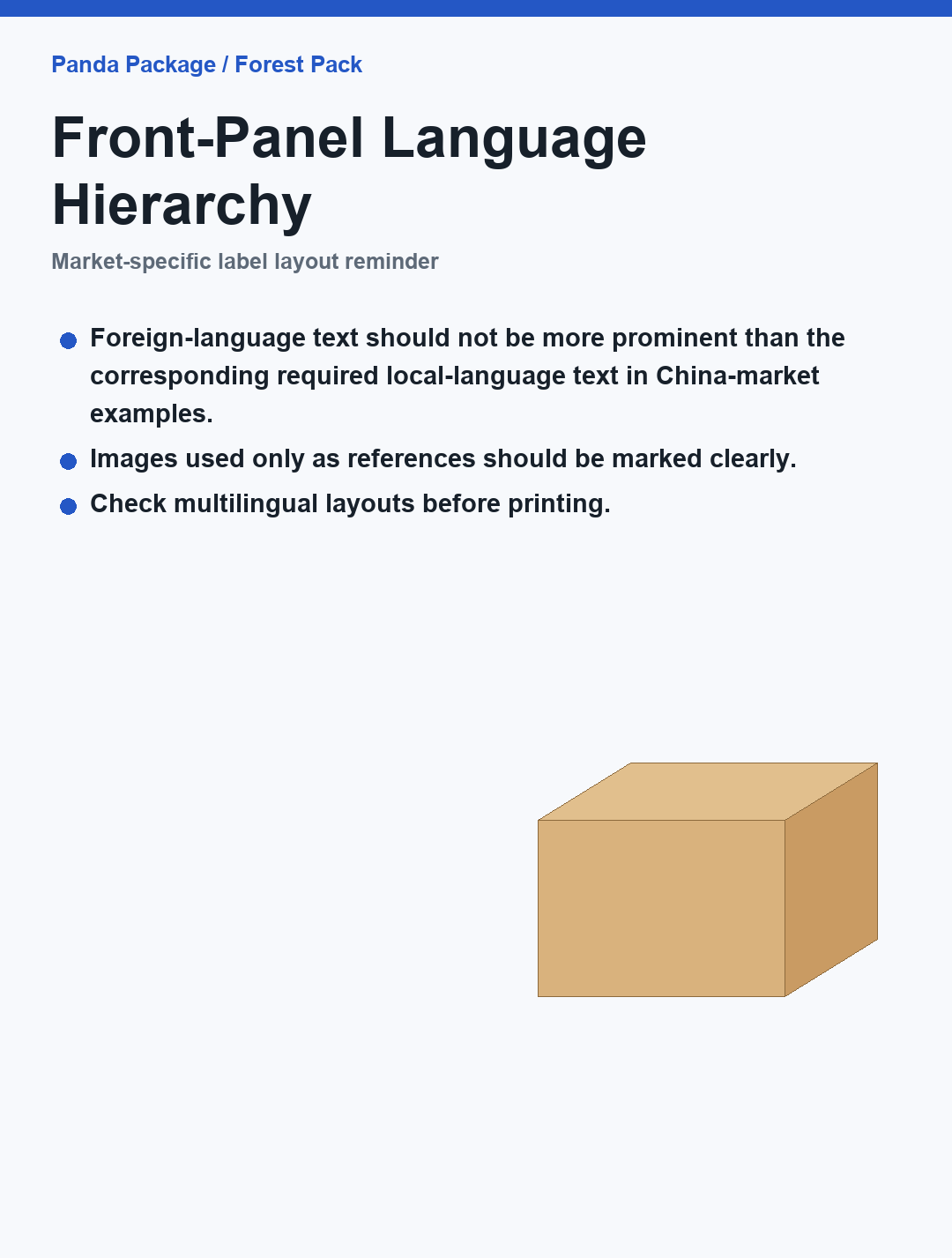
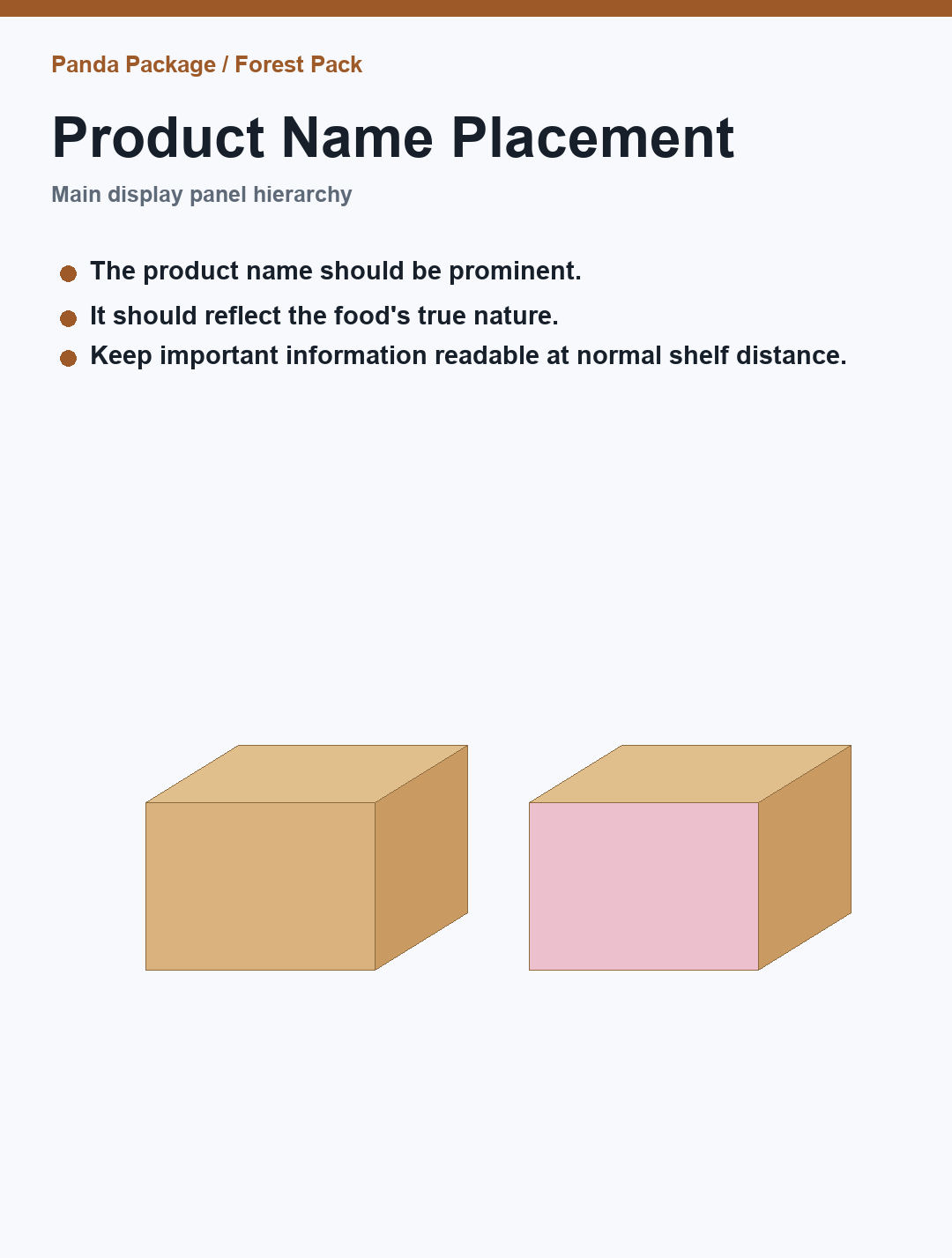
The product name should describe what the food actually is. Creative names, flavor names, brand names, and marketing names can work well, but they should not confuse customers about the real product category.
Avoid names or claims that imply health, medical, slimming, whitening, anti-aging, or therapeutic effects unless those claims are legally approved.
Name and claim examples have been remade in English for easier scanning.
6. Keep Packaging Premium Without Making It Excessive
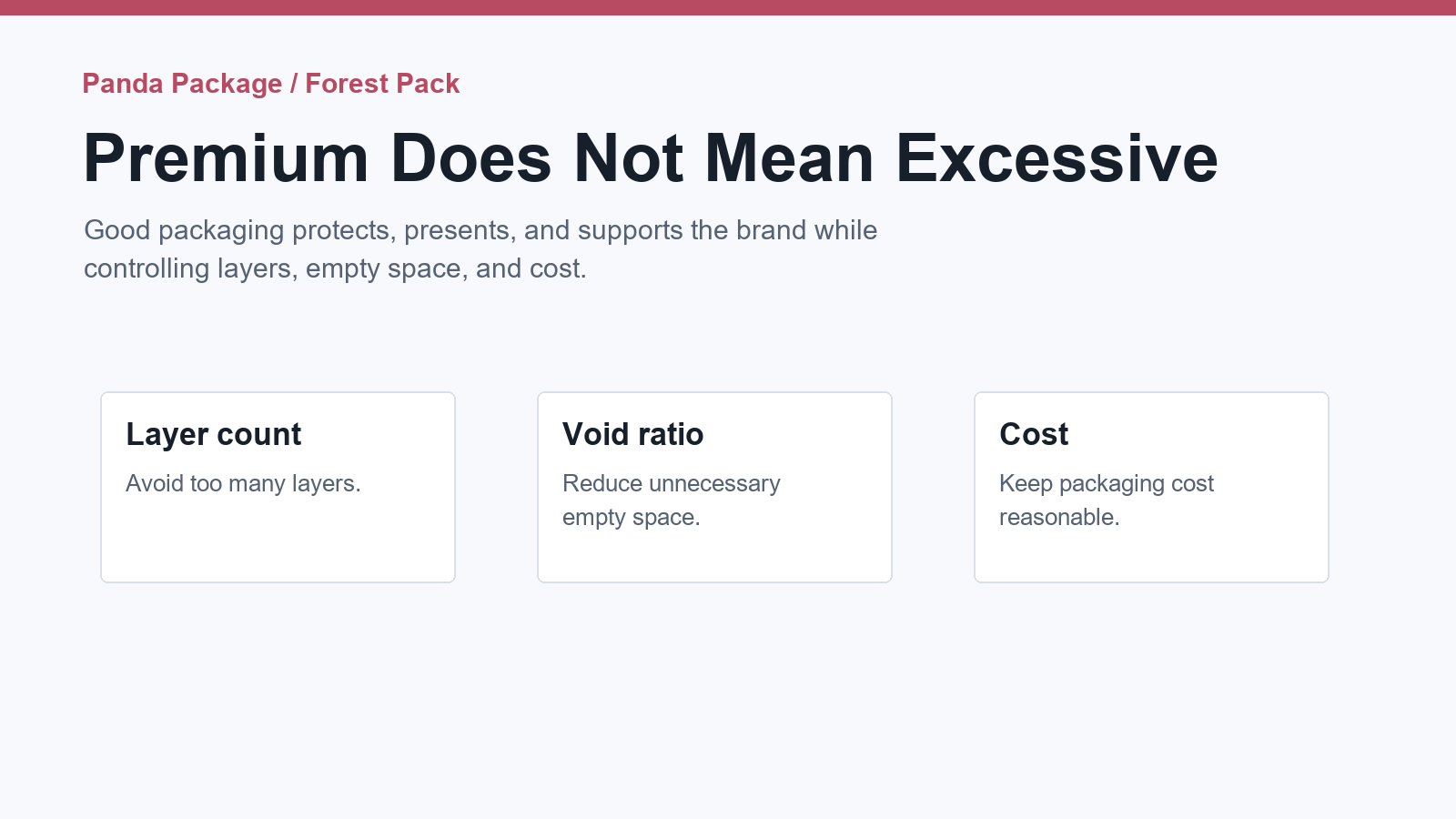
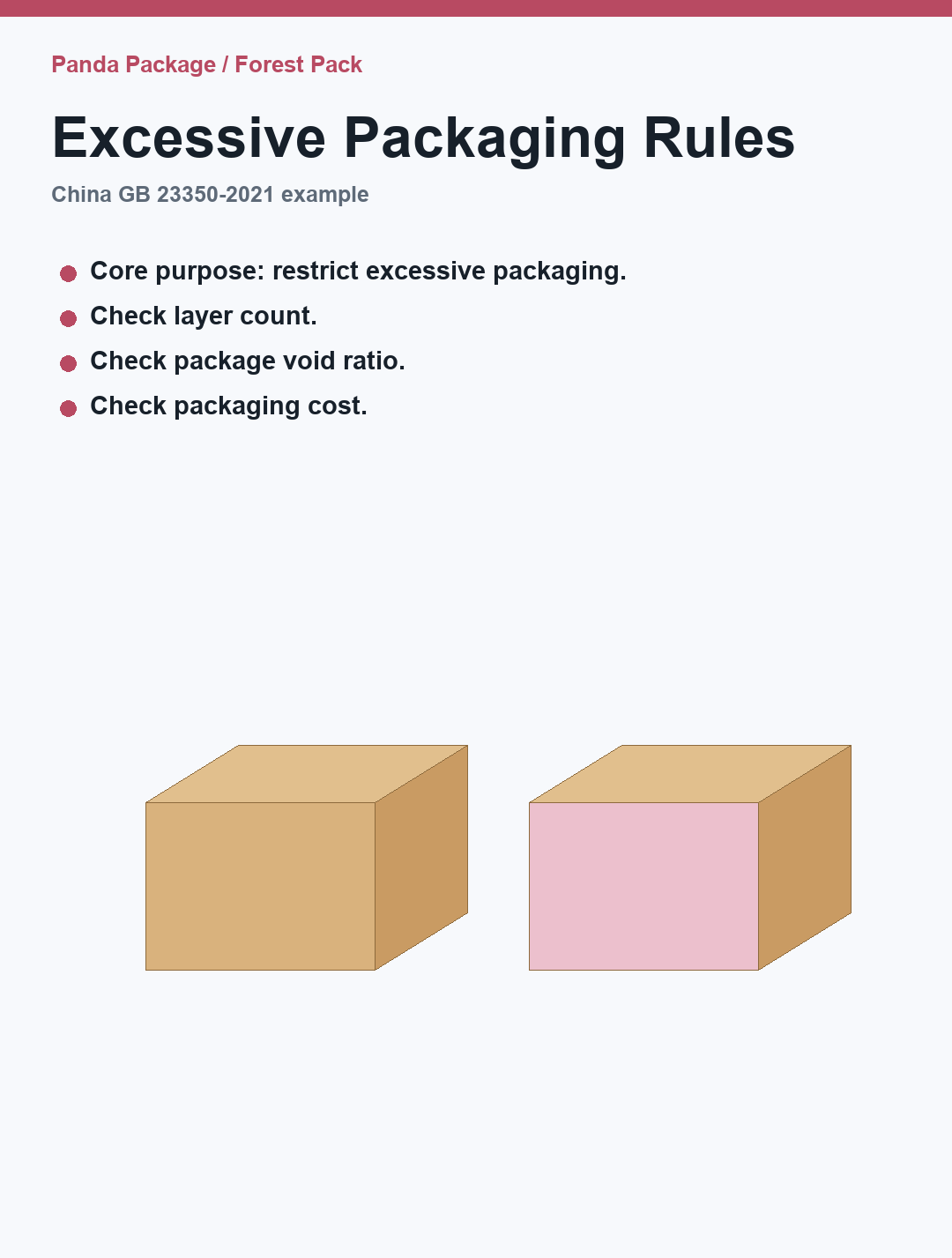
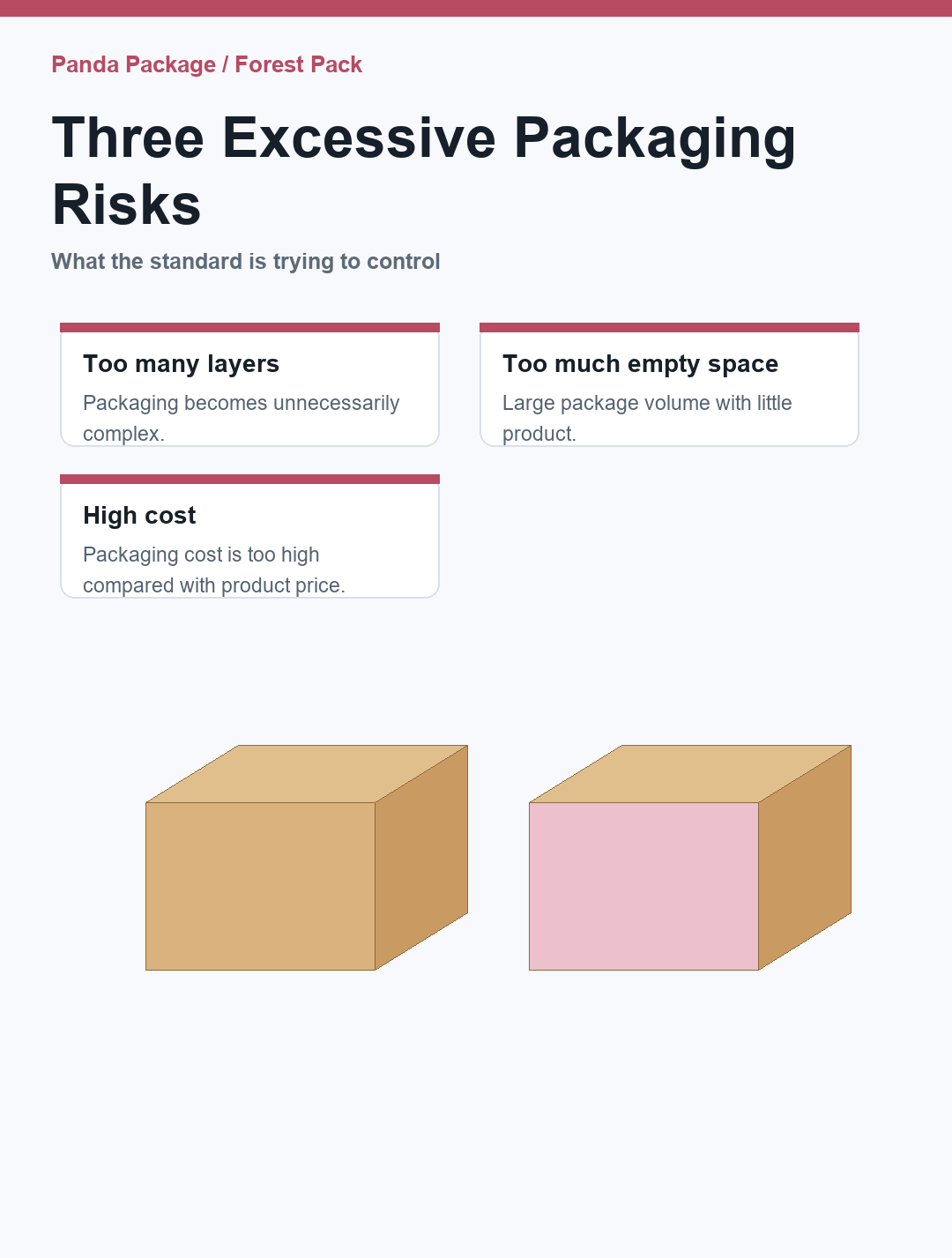
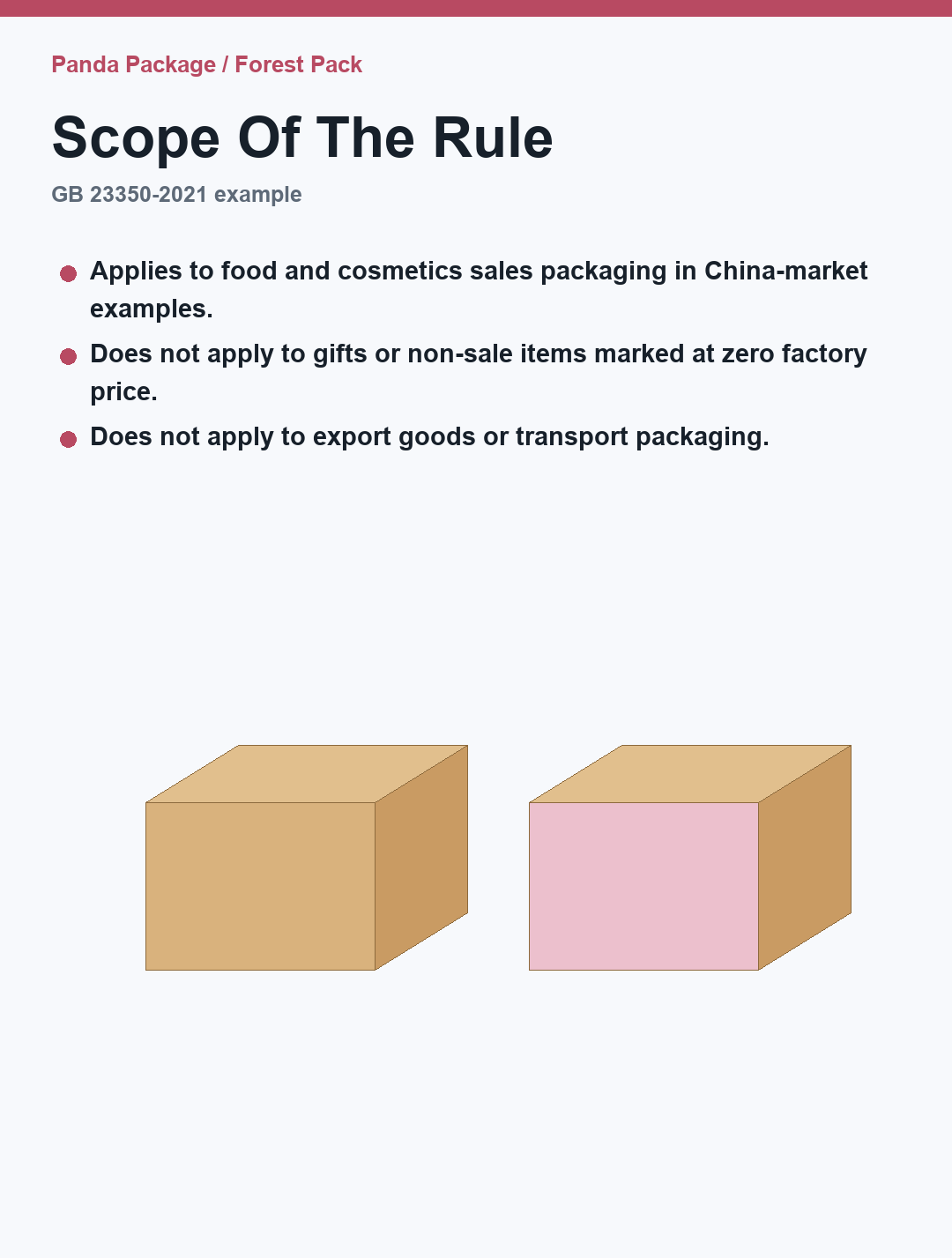
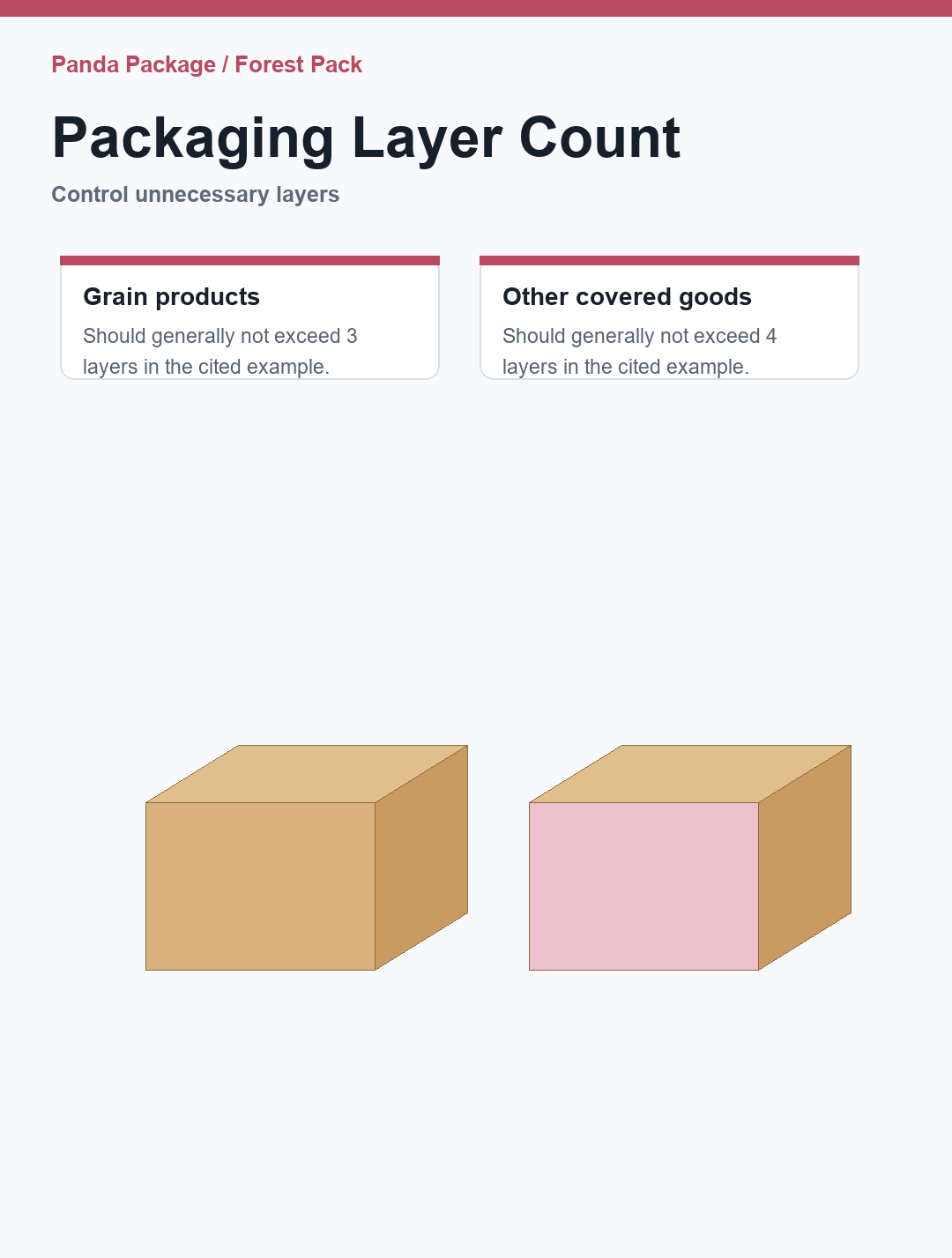
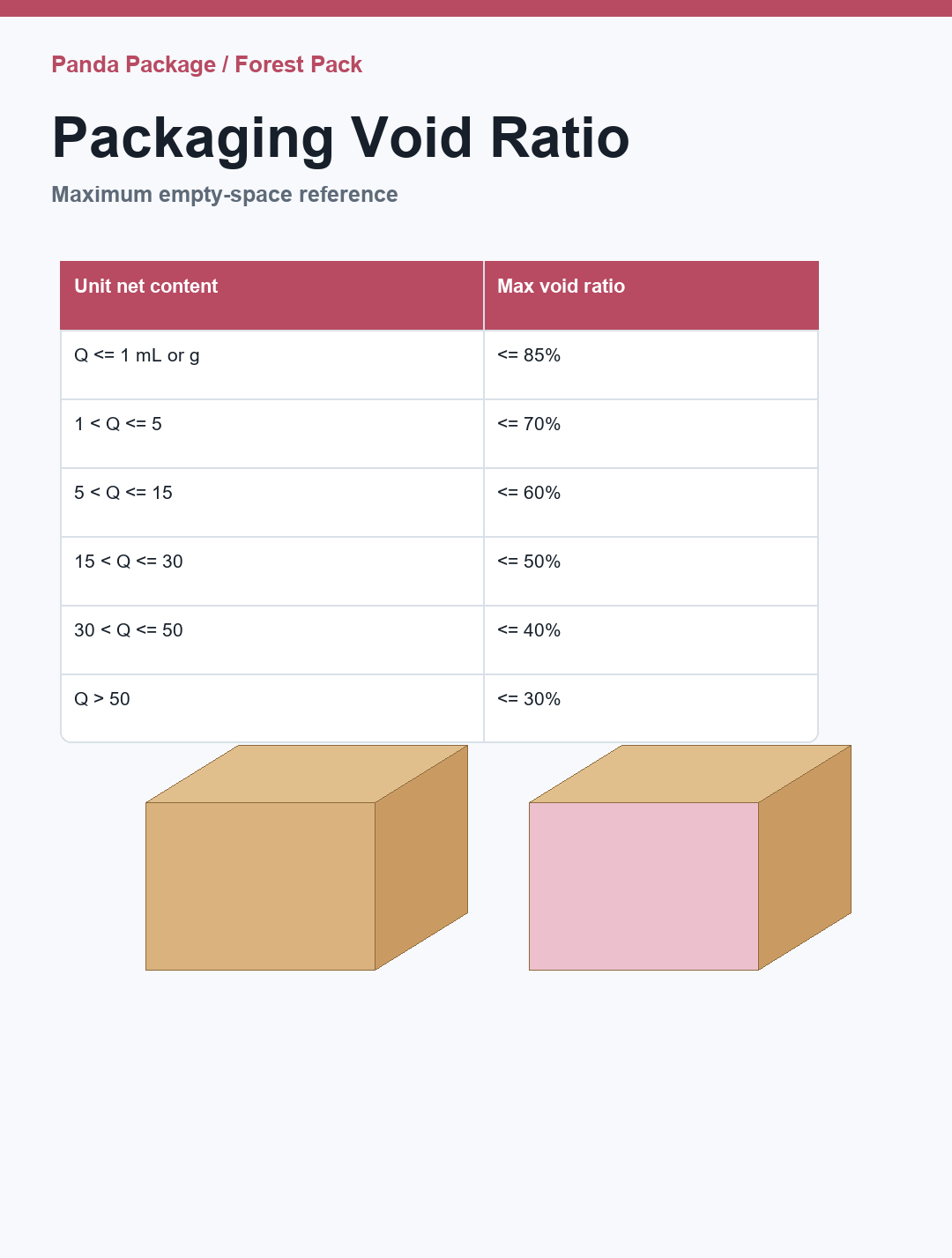
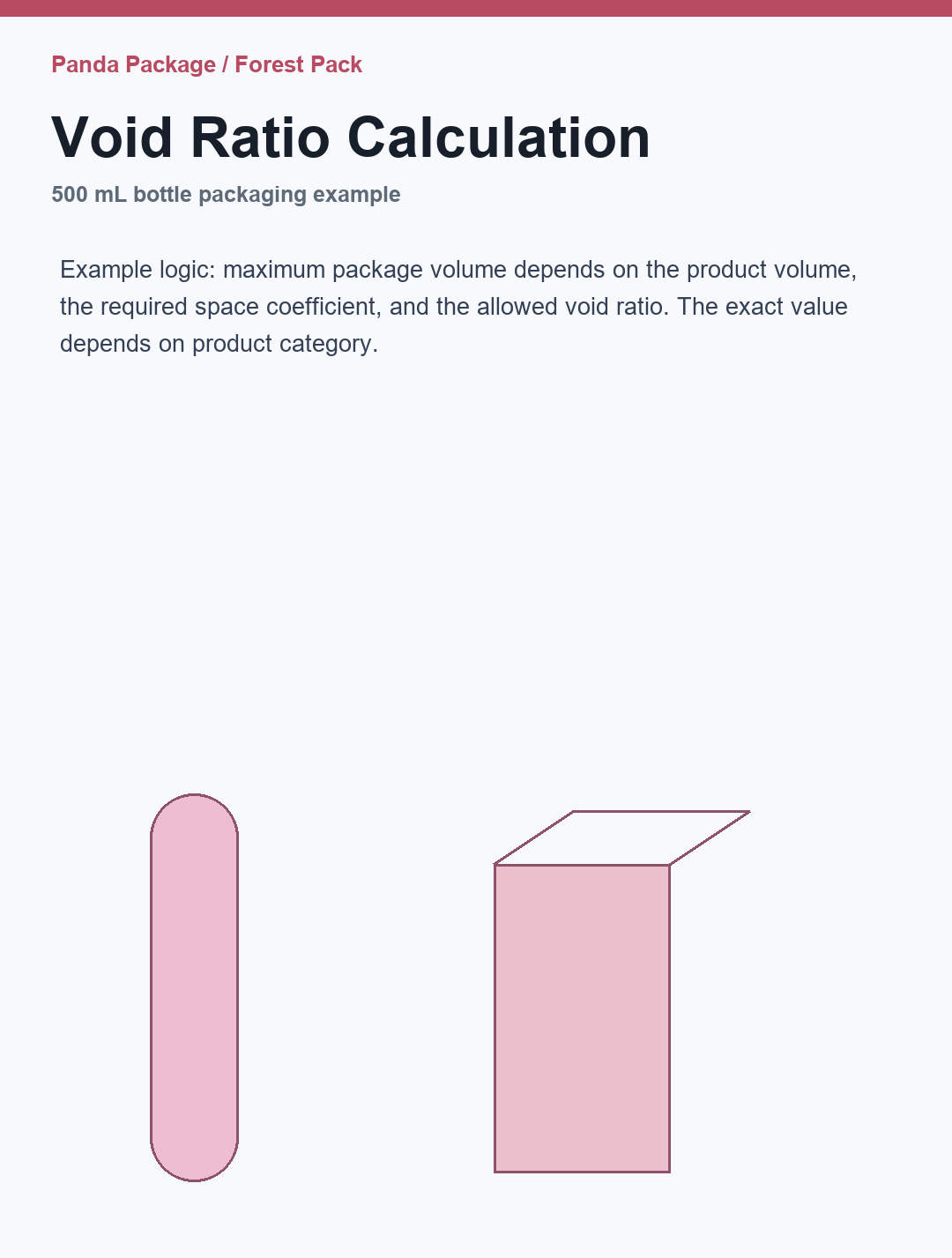
Premium packaging should protect the product and improve presentation, but it should also control material use, empty space, and cost. For China-market food and cosmetics packaging, GB 23350-2021 focuses on layer count, void ratio, and packaging cost.
These diagrams have been remade in English to avoid Chinese-heavy visuals.
7. Convert Font Size To Real Printed Height
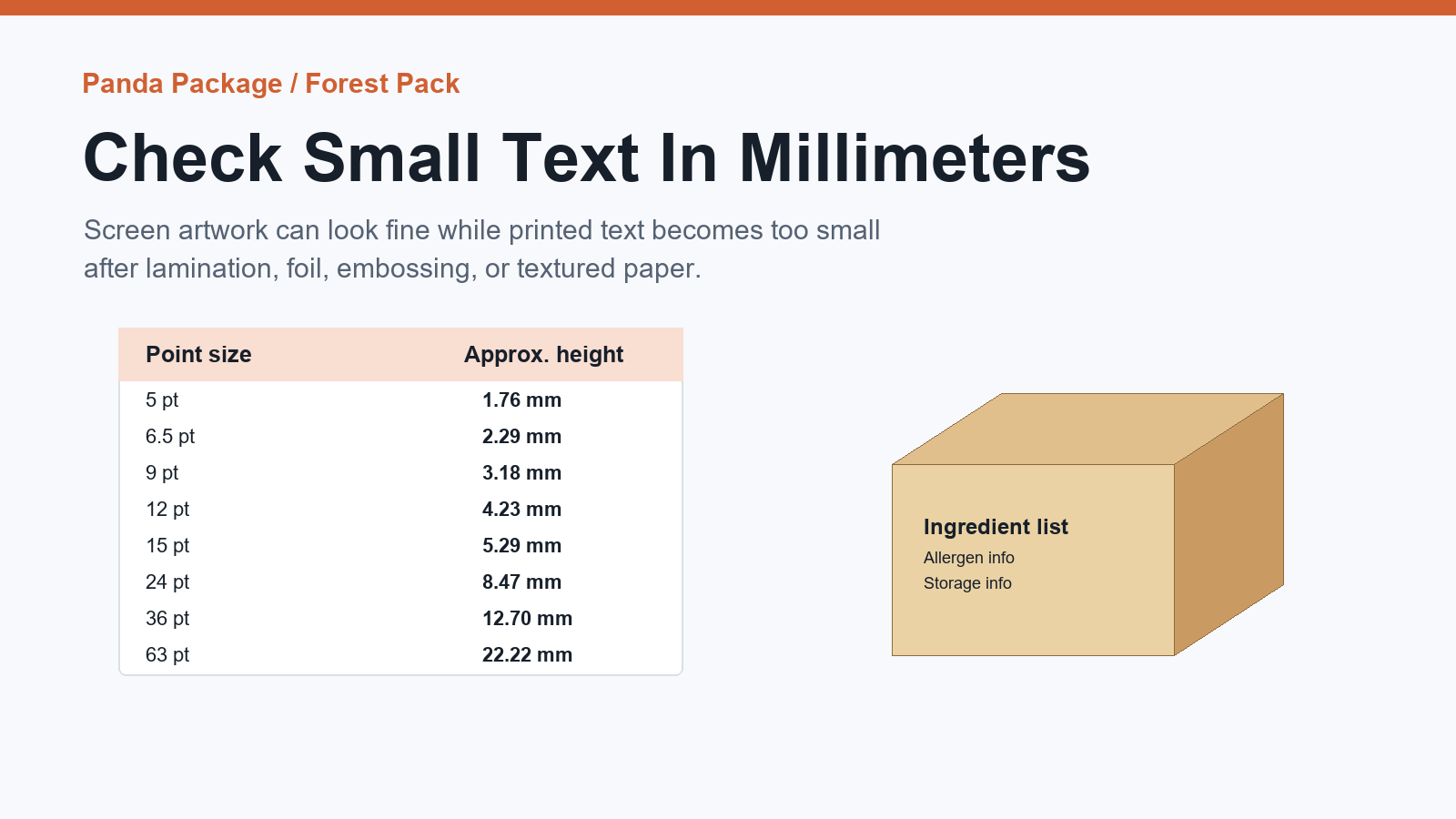
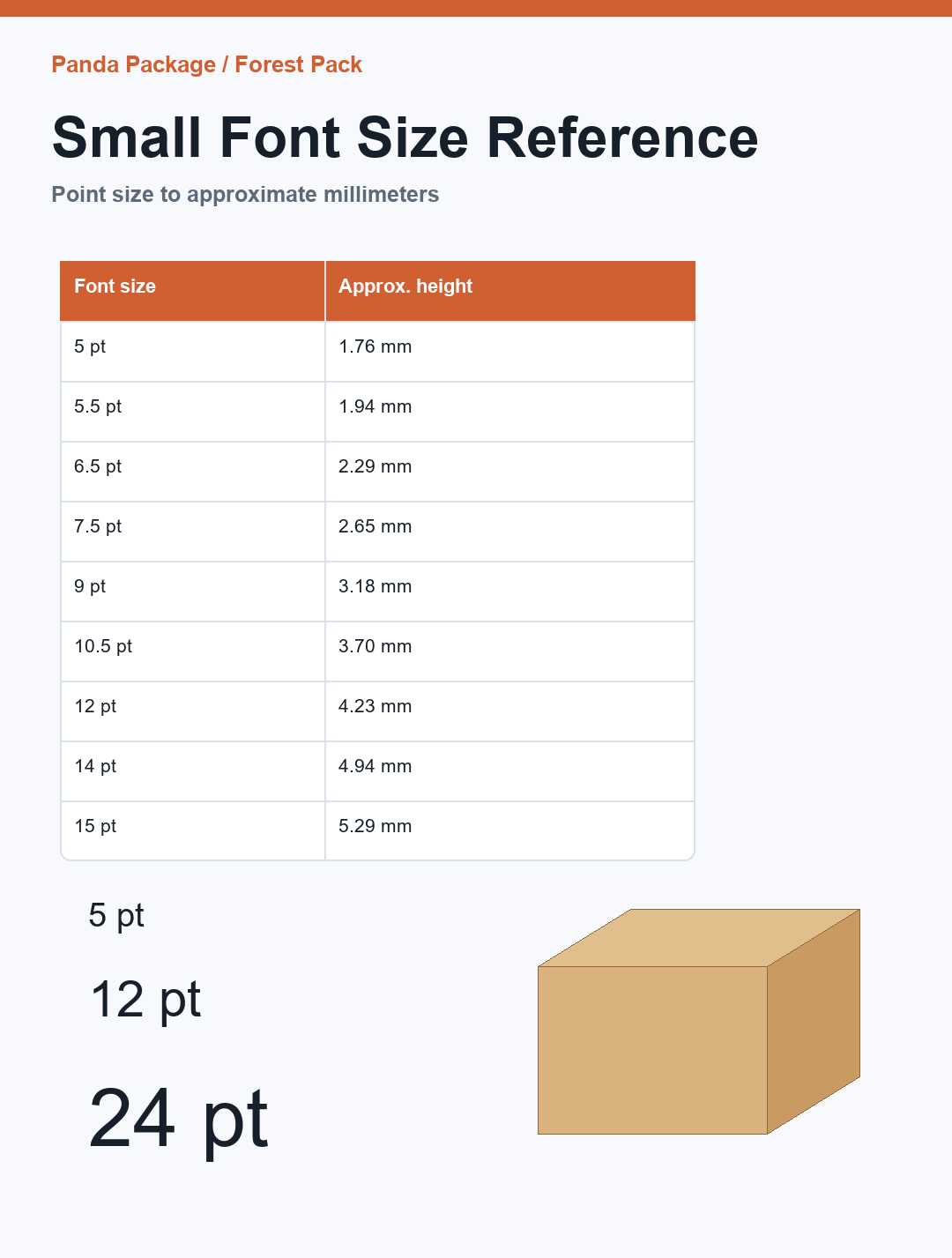
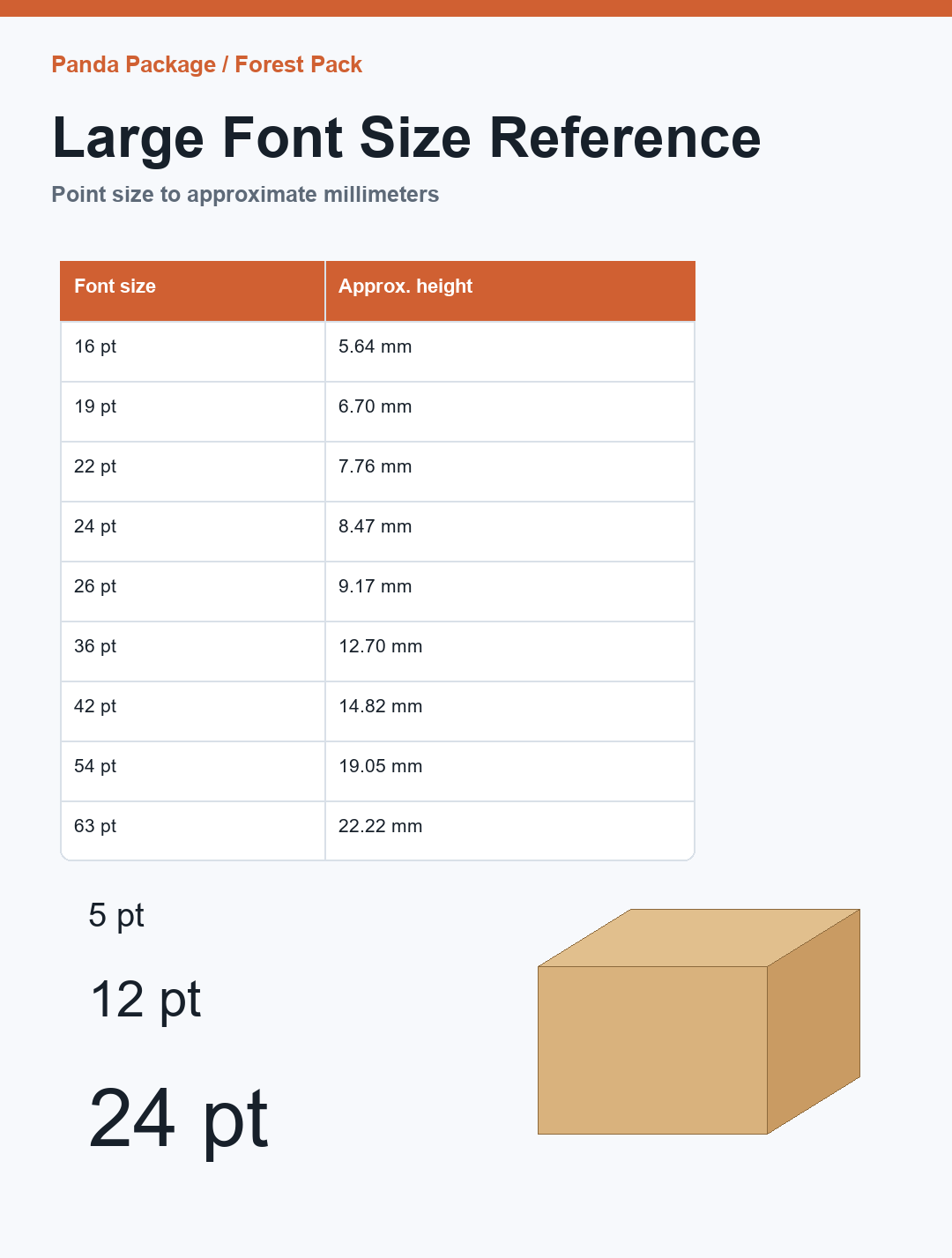
Designers often work in points, but packaging compliance and readability are usually checked in millimeters. Text may become less readable after lamination, foil stamping, embossing, debossing, spot UV, or textured paper.
| Font Size | Approx. Height | Font Size | Approx. Height |
|---|---|---|---|
| 5 pt | 1.76 mm | 16 pt | 5.64 mm |
| 6.5 pt | 2.29 mm | 22 pt | 7.76 mm |
| 9 pt | 3.18 mm | 24 pt | 8.47 mm |
| 12 pt | 4.23 mm | 36 pt | 12.70 mm |
| 15 pt | 5.29 mm | 63 pt | 22.22 mm |
The point-size charts have been remade in English.
8. Production Workflow
- Confirm the target market and label language.
- Confirm whether the product has direct food contact with the packaging.
- Choose the packaging structure and material.
- Prepare the dieline and reserve space for label information.
- Add net content, date, storage, barcode, and claims carefully.
- Review packaging layers and empty space.
- Check barcode size, quiet zones, and scan performance.
- Check small text size in millimeters.
- Produce and review a physical sample before mass production.
Related Packaging Solutions
If you are preparing a food packaging project, these Panda Package pages may help you compare structures, materials, and sample directions:
Paperboard BoxesLightweight folding cartons for snacks, bakery, candy, supplements, and retail food products.
Food Pouch PackagingFlexible pouches for coffee, tea, snacks, powders, and dry food products.
Custom Paper BagsBranded paper bags for retail, bakery, takeaway, gift, and promotional use.
Box InsertsCustom inner trays and inserts to hold jars, bottles, accessories, and gift sets.
Coffee PackagingCoffee boxes and bags for beans, grounds, drip coffee, and discovery sets.
FAQ
Can Panda Package make direct food contact packaging?
Yes, suitable food-contact materials and coatings can be recommended according to the product, moisture, grease level, filling method, and target market. Certification requirements should be confirmed before sampling.
Should I check artwork compliance before making a sample?
Yes. It is better to reserve label space, barcode space, date-code location, and net content size before printing the first sample.
Can the same outer box use different inserts?
Usually yes. Modular inserts can help brands use one outer box for several product configurations, as long as product size, weight, and protection needs are confirmed early.
Need Help With Custom Food Packaging?
Panda Package can support food packaging projects from structure to production, including paperboard boxes, food pouches, paper bags, sleeves, paper tubes, inserts, and gift-style packaging. We can help review material choices, dielines, printing processes, finishing options, barcode placement, and sample production before mass manufacturing.
References
Original article: WeChat article. Other references include China NHC GB 7718-2011 and GB 7718-2025 materials, SAC GB 23350-2021 Q&A, and GS1 barcode guidance.